
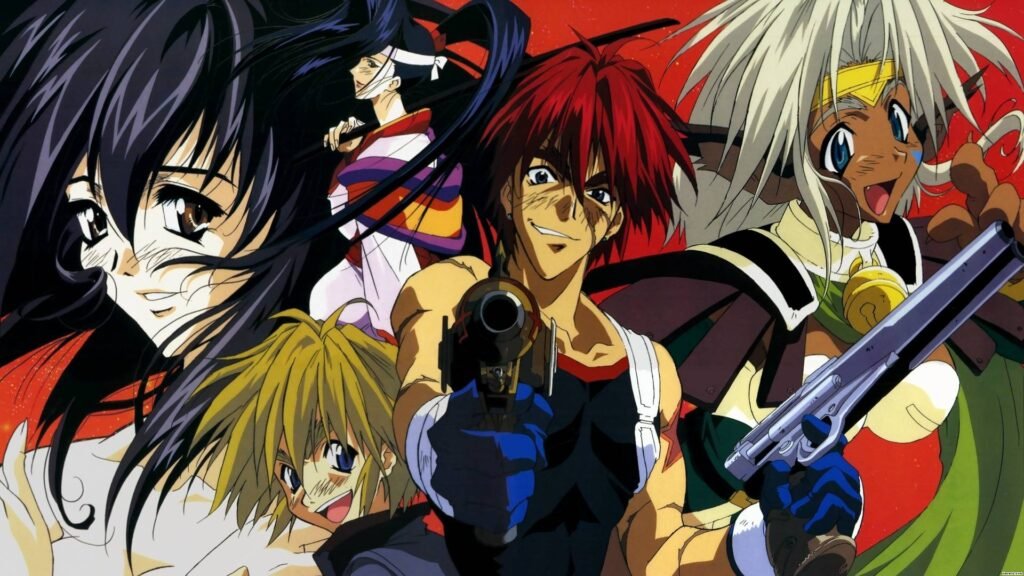
Outlaw Star Was Made by the Same Studio as Cowboy Bebop, Released Months Earlier, and Got Completely Overshadowed. The Fans Who Found It on Toonami Never Let Go.
By Jimigrimm
You probably discovered Outlaw Star by accident. Maybe it was the show that came on after something else you were watching. Maybe a friend mentioned it once and you gave it a shot. Maybe you just happened to be sitting in front of the TV at the right time on the right day. However you found it, the same thing happened: you watched Gene Starwind fire a Caster gun, fly a ship that fought with giant mechanical arms, and chase a treasure across the galaxy with a crew of misfits who had no business working together. And you thought, “Why is nobody talking about this show?”
That question has followed Outlaw Star for over two decades. The answer has nothing to do with quality and everything to do with timing.
Sunrise Made Two Space Westerns. Only One Became Famous.
Outlaw Star was created by Takehiko Ito, originally serialized as a manga in Shueisha’s Ultra Jump magazine starting in 1996. The manga ran for only 21 chapters across three volumes and never received an official English release. The story was never finished on the page. It fell to the anime to complete what the manga couldn’t.
Sunrise Studios produced the 26-episode anime adaptation, which aired in Japan on TV Tokyo in early 1998 in a late-night time slot. The show was a space opera blending science fiction, fantasy, martial arts, and Chinese cultural influences into something that didn’t fit neatly into any genre. Gene Starwind was a bounty hunter afraid of space travel. His partner Jim Hawking was an 11-year-old mechanic who was the brains of the operation. Their crew included a bio-android named Melfina who was literally the navigation system of their ship, a contract killer named Suzuka who wore a kimono, and Aisha Clanclan, a cat-girl alien from the Ctarl-Ctarl Empire who could transform into a tiger.
The ship itself was designed by Shoji Kawamori, the legendary mecha designer behind Macross. The Outlaw Star was a Grappler ship, meaning it fought other ships with giant mechanical arms in close-quarters space combat. That detail alone made the show unlike anything else in the genre.
But here’s the timing problem. Sunrise released Outlaw Star in January 1998. A few months later, the same studio released Cowboy Bebop. Both were space adventure series with ragtag crews, bounty hunting premises, and genre-blending sensibilities. Cowboy Bebop became one of the most acclaimed anime of all time. Outlaw Star became a cult classic that most people discovered years later, if they discovered it at all.
Toonami Gave It a Home. The Fans Fought to Keep It.
The English dub premiered on Toonami on January 15, 2001, heavily edited for content. The show had adult themes that didn’t translate easily to afternoon television. Profanity was cut. Violence was trimmed. Nudity was digitally covered by adding clothing to characters frame by frame. Episode 23, set on a hot spring planet, was pulled entirely and didn’t air in America for over 15 years. The role of Fred Luo, a recurring gay character, was considerably toned down because Cartoon Network’s policy prohibited “overt sexuality or implied sexuality of any kind.”
Get the history behind the stories.
One email a week. Read it before it hits the feeds.
Even with the edits, the show connected. It wasn’t Dragon Ball Z numbers. It wasn’t Gundam Wing numbers. But the audience it found was fiercely loyal. When Cartoon Network ran an online poll in the summer of 2001 asking fans which show should return to Toonami, Outlaw Star received approximately two-thirds of the more than 150,000 votes cast. Two-thirds. The fans didn’t just like the show. They organized to bring it back.
Outlaw Star returned and also aired on the Midnight Run and later on Adult Swim, where it ran with minimal edits through 2002. The Adult Swim broadcast pulled a Nielsen rating of 0.9, up 125 percent for that time slot, with 414,000 viewers in the 18 to 34 age range, up 135 percent. For a show that had been overshadowed since the day it premiered, those numbers proved something the fans already knew: Outlaw Star had an audience. The industry just kept forgetting to look for it.
26 Episodes. No Filler. No Wasted Breath.
Outlaw Star was 26 episodes. No filler. No padding. The story moved from start to finish without wasting a single episode on something that didn’t matter. In an era where Dragon Ball Z stretched five minutes of story across ten episodes, and Naruto would later bury its audience under 85 consecutive filler episodes, Outlaw Star respected your time. You could watch the entire series in a weekend and walk away feeling like you’d experienced a complete story.
The show also did something unusual for Toonami-era anime: it blended genres without apologizing for it. There were space battles and martial arts. There were Caster guns that fired magical shells and required specific ammunition like bullets in a revolver. There was Chinese mythology woven into the architecture and culture of the universe. There was a legitimate treasure hunt driving the entire plot. Ito described the series as a more mature, scientific approach compared to his earlier space manga, but then filled it with wizards, pirates, and cat-girls. The contradiction was the point. The universe of Outlaw Star didn’t follow rules borrowed from other space operas. It made its own.
There’s a moment late in the series where the crew finally reaches the Galactic Leyline, the treasure they’ve been chasing for the entire show. After 25 episodes of fighting, running, scraping together money to keep the ship fueled, and nearly dying more times than any of them can count, they arrive. And what they find isn’t what they expected. The Leyline doesn’t hand them a reward. It asks them a question. And Gene, the guy who spent 25 episodes talking like nothing could touch him, who flirted his way out of problems and shot his way out of the rest, stands there and gives an answer so honest it sounds like it came from a completely different person. The bravado drops. The voice changes. You’re watching a man admit what he actually wants out loud for the first time in his life, and it’s not money, it’s not fame, it’s not the treasure. If you were sitting in your living room watching this on Toonami, that was the moment the show stopped being a fun space adventure and became something you carried with you. The screen didn’t shake. Nobody powered up. Gene just told the truth, and it hit harder than any fight in the entire series.
The Sequel That Never Happened
Morning Star Studio, Ito’s production team, drafted plans for a sequel called Outlaw Star 2: Sword of Wind. Character designs were created. A plot outline was posted on their official website. The story would have picked up years after the original, following Gene and Jim on a new ship. It never got made. Ito said the franchise wasn’t popular enough in Japan to justify production, and the animation director’s schedule was too full. The sequel exists only as a concept, permanently frozen in development.
There is a persistent rumor in the anime community that Joss Whedon’s Firefly borrowed the image of a naked woman discovered inside a box from a nearly identical scene in Outlaw Star. Whedon has never confirmed the connection, but the parallels between the two shows, a ragtag crew on a ship in a frontier-style space setting, a mysterious woman discovered in a container, a blend of Western and Asian cultural influences, are specific enough that fans have been pointing them out since Firefly premiered. Whether the influence was direct or coincidental, Outlaw Star was doing what Firefly would do years later, and doing it in animation where the scope was unlimited.
The show has never been rebooted. It has never been remade. It has never been continued. It exists as 26 episodes and a manga that never finished, and the fans who watched it on Toonami treat it like a secret they’ve been keeping for over two decades.
Were you one of the fans who voted to bring Outlaw Star back? Did you discover it on the afternoon block or the Midnight Run? Which crew member was your favorite, and which moment made you realize this show was different from everything else on the block? And if you’ve never seen it, this is your sign. It’s 26 episodes. No filler. No excuses. We want to hear from the fans who’ve been waiting to talk about this show.
MORE LIKE THIS
-
Cowboy Bebop Became the Show Every Anime Fan Recommends to People Who Don’t Watch Anime. The Reason It Works Is That It Was Never Really Made for Anime Fans in the First Place.
6 MIN READ -
Serial Experiments Lain Was Made by a Team With Almost No TV Anime Experience. The Character Designer Had Never Worked on an Anime Before.
5 MIN READ -
Gungrave Launched as a Game and an Anime at the Same Time. Only One of Them Became a Tragedy People Never Forgot.
5 MIN READ

Co-founder and co-host. Veteran. Grew up on cartoons. The MCU brought all of it back and pulled him into the comics side he never picked up as a kid. Curious by default. Passionate without needing to prove anything. Good at holding a conversation.