
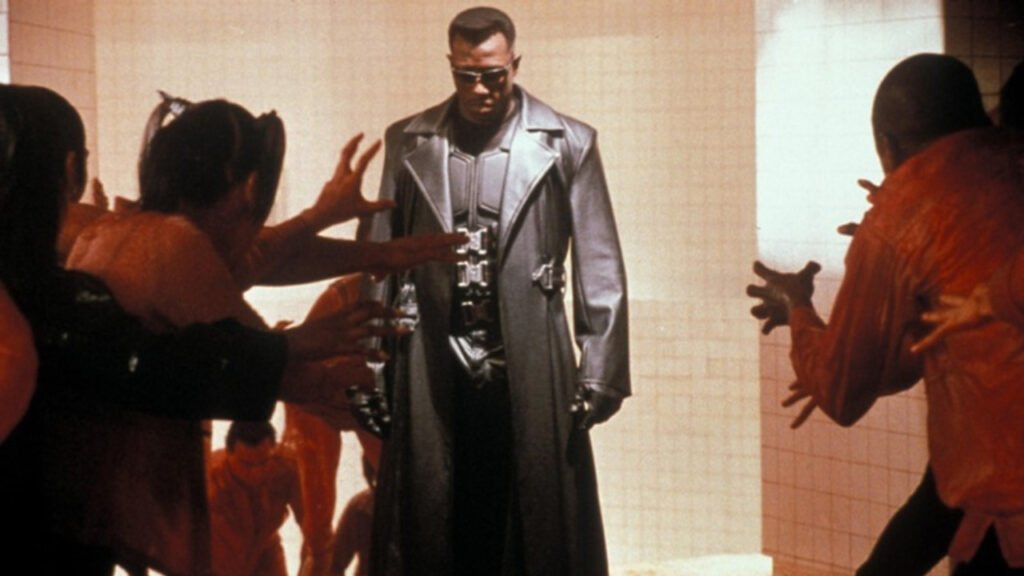
Blade Was a Hit While Marvel Was in Bankruptcy. Marvel Reportedly Got About $25,000.
By Jimigrimm
If you saw Blade in August 1998, you remember the opening. A vampire nightclub, sprinklers raining blood, and Wesley Snipes walking in to clear the room. Director Stephen Norrington later said he had to fight a studio executive to keep that scene in the movie.
Blade opened at number one. It made about $131 million around the world and turned a vampire hunter most moviegoers had never heard of into a franchise. And when it hit theaters, the company that owned him was still in bankruptcy. People say Blade saved Marvel. The court records and filings tell a different story, and it starts with how little Marvel got paid.
Marvel Was Falling Apart
Ron Perelman bought Marvel on January 6, 1989, for $82.5 million, and then went on a spending run. Court records show Marvel bought the trading card company Fleer for $286 million, the sticker company Panini for $158 million, and SkyBox for $165 million. The collector boom of the early ’90s made it all look smart. When the speculator market crashed, comics and trading cards went down together, and the debt made it worse.
By June 1996, Marvel had announced 275 layoffs and deep publishing cuts. On December 27, 1996, Marvel and its subsidiaries filed for Chapter 11. What followed was a fight for control between Perelman, bondholders led by Carl Icahn, secured lenders, and Toy Biz. The final reorganization plan was approved on July 31, 1998, and completed on October 1, 1998, when Toy Biz took over and became Marvel Enterprises.
Blade opened right in the middle of that, on August 21, 1998. The plan that pulled Marvel out of bankruptcy was approved three weeks before the movie hit theaters.
Blade Was Licensed Before Any Of That
Blade first appeared in The Tomb of Dracula #10, cover-dated July 1973, created by writer Marv Wolfman and artist Gene Colan. For the next two decades he was mostly a supporting player in Marvel’s horror books, with a stint in Nightstalkers and a ten-issue solo series in 1994 and 1995. David S. Goyer, who wrote the movie, has called him a third-tier character.
The movie rights were licensed years before the bankruptcy. A federal court opinion identifies a Blade motion picture license dated December 24, 1993, held by New Line as the successor to Katja Picture Corporation. A 1992 Variety report described in a later Film Stories piece linked LL Cool J to an early version of the project, but there’s no record of him signing on.
The same court case settled a fight over who owned Blade. Wolfman filed a claim in Marvel’s bankruptcy in January 1997 and sued in August 1998, with period coverage putting his demand at $35 million or more. In November 2000, the court ruled the characters were works made for hire owned by Marvel.
How New Line Built It
Goyer’s own account of the development is on his official site. Around 1994, New Line executive Michael De Luca wanted a Black superhero movie. “New Line wanted to make a film in the 8 million range,” Goyer wrote. His script pushed the scale toward $45 million. Goyer also recalls the studio asking at one point whether Blade could be white. David Fincher was involved for a stretch of development before Norrington got the job.
Snipes signed on as star and producer. In a 2018 Entertainment Weekly oral history, he connected Blade to his failed attempt to make a Black Panther movie earlier in the ’90s, and Blade became the Marvel project he actually got made.
Get the history behind the stories.
One email a week. Read it before it hits the feeds.
The ending changed late. Norrington told the Take A Look Around podcast that the original finale, with a digital Blood God, was beyond what the effects budget could deliver, so it was reshot. He also said the Moscow ending came at the studio’s insistence, replacing a rooftop scene. Fans have long called the figure in that cut rooftop scene Morbius. Norrington says it wasn’t specifically meant to be him.
A Number One Opening
Blade opened on August 21, 1998, rated R, and took in $17.07 million in its first weekend in 2,322 theaters. It was number one that weekend and the next. The Numbers lists a $45 million production budget and about $70 million domestic and $131 million worldwide. Spawn had opened bigger in 1997, but Blade finished with more money in the US.
Critics were split then and still are. Metacritic has it at 47 out of 100. Rotten Tomatoes shows 59% from critics and 78% from audiences, so the crowd liked it more than the reviewers did.
Marvel Reportedly Got About $25,000
A 2005 court opinion in Stan Lee’s lawsuit against Marvel describes Marvel’s Blade deal as a share of defined net profits, and says that share paid Marvel nothing. On paper, the movie never made a net profit for Marvel to share in.
How much Marvel got at all is still fuzzy. Producer Peter Frankfurt, quoted from the book MCU: The Reign of Marvel Studios, put it this way: “I think Marvel was paid $25,000.” That’s a recollection, not a ledger, but it’s the number on the record. In the same 2005 case, Avi Arad testified about net profit deals: “it’s expensive and it’s hard to monitor, and therefore I’m allergic to it.”
The court connected Blade’s deal to Marvel turning against that kind of accounting, and contrasted the Blade deal with Sony’s Spider-Man agreement, which paid Marvel off the gross instead of the net. And none of Blade’s ticket sales paid Marvel’s way out of bankruptcy. The reorganization was approved before the movie opened, and no document ties Blade money to the creditors.
What Blade Actually Proved
What Blade proved was that a character nobody knew could carry a hit. Kevin Feige said it plainly in a 2017 interview with JoBlo: “It doesn’t matter how well known the character is, it matters how cool the movie is.” That’s the same bet Marvel Studios made on Iron Man a decade later.
The people who made Blade are more careful about the credit than the fans are. “I’m not sure Blade was as influential as all that,” Norrington said in 2021. Snipes, looking at the superhero genre in 2018, said “we can’t by any means take full responsibility for any of that.”
The timeline backs them up on some of it. Fox was already developing X-Men before Blade came out. Sony and Marvel announced their Spider-Man deal on March 1, 1999, tied to settling rights fights, not to Blade. What Blade did was show Marvel what a bad deal looked like. In 2005, Marvel closed a $525 million financing deal to make its own movies and keep control. Iron Man came out of that slate on May 2, 2008.
The Franchise After
Blade II arrived on March 22, 2002, directed by Guillermo del Toro, and made about $154 million worldwide. Blade: Trinity followed on December 8, 2004, with Goyer directing, and made about $131 million. In 2005, Snipes sued over Trinity, claiming he’d been shut out of decisions and owed money. Reports at the time differed on the details, and how the suit ended isn’t on the record.
Spike’s Blade TV series premiered on June 28, 2006, with Kirk “Sticky” Jones in the role, and was cancelled that September. Snipes came back as Blade in Deadpool & Wolverine in 2024, twenty years after Trinity.
Marvel Studios announced Mahershala Ali as Blade at San Diego Comic-Con on July 20, 2019. After two directors, a strike shutdown, and a release date pulled from the calendar, Ali told GQ in July 2026 the movie wasn’t happening. “Not with me.” We covered that collapse in Why Does Marvel Keep Canceling Projects? and in Blade, Armor Wars, Wonder Man, and What Marvel Protects When It Cuts.
What's On The Record And What Isn't
Confirmed by court records and filings: the 1993 license, Marvel’s December 1996 bankruptcy, the reorganization approved before Blade opened, the net profit deal that paid Marvel nothing, and the ruling that Marvel owns Blade. The box office numbers come from The Numbers and Box Office Mojo, which differ by about $54,000 on the domestic total.
Not established: Marvel’s exact lifetime earnings from Blade, the movie’s audited profit, the details of the early LL Cool J and comedy versions, and how Snipes’ Trinity lawsuit ended. The popular claim that Blade’s money kept Marvel alive isn’t supported by any document. What the record supports is a hit Marvel barely got paid for, and a lesson Marvel built its own studio around.
Did you catch Blade in theaters in 1998, or find it later on cable or DVD? And which movie do you think did more to set up the superhero era, Blade, X-Men, or Spider-Man?
MORE LIKE THIS
-
Blade, Armor Wars, Wonder Man, and What Marvel Protects When It Cuts
9 MIN READ -
Why Does Marvel Keep Canceling Projects? Blade Is Dead After Seven Years, Wonder Man Lost a Season It Was Already Promised, and the Real Answer Is On the Record.
7 MIN READ -
How Marvel Got From Endgame to Doomsday: The Deals, the Disasters, and the Seven Years Nobody Planned
7 MIN READ

Co-founder and co-host. Veteran. Grew up on cartoons. The MCU brought all of it back and pulled him into the comics side he never picked up as a kid. Curious by default. Passionate without needing to prove anything. Good at holding a conversation.