
In Darker Than Black, Every Superpower Comes With a Cost. One Character Has to Break His Own Fingers After Every Use.

One character has to smoke cigarettes after every use of his power. He hates smoking. Doesn’t matter. The remuneration is mandatory. Another has to drink beer, and she’s the rare Contractor who actually enjoys her payment. Another’s remuneration involved drinking the blood of children. These aren’t choices. They’re mandatory payments called “remunerations” that every Contractor in Darker Than Black has to make after using their abilities. The cost is involuntary, irrational, and different for every person. You don’t pick your price. It picks you.

That system is why this show sticks with people. Superpowers in most anime are gifts. In Darker Than Black, they’re transactions. Every ability comes with a receipt, and the receipt is always strange, sometimes disgusting, and occasionally horrifying. It makes every fight scene a calculation: is the mission worth what I’ll have to do to myself afterward?

The Setup

The show is set in a version of Tokyo where two anomalies called Hell’s Gate and Heaven’s Gate appeared ten years earlier, altering the sky and the landscape. The real stars disappeared. A fake sky replaced them, and each new star corresponds to a Contractor. When a Contractor dies, their star falls. When a Contractor uses their power, their star pulses. The sky is a map of everyone with abilities, and the organizations tracking those stars use them to monitor Contractor activity.

Around the time the Gates appeared, people with supernatural abilities started emerging. They’re called Contractors because their abilities function like a contract: power in exchange for something taken. The other part of the deal is emotional. Contractors can still feel, but emotions don’t drive their decisions the way they do for most people. They think rationally. They calculate. They prioritize logic over connection. Governments and shadowy organizations use them as operatives because a person whose emotions don’t get in the way makes an efficient weapon. Whether Contractors truly can’t feel or simply suppress what they feel is something the show keeps asking.

25 episodes. Produced by Studio Bones. Scored by Yoko Kanno. Premiered on MBS in April 2007. Original anime, not adapted from any manga or novel.

Hei

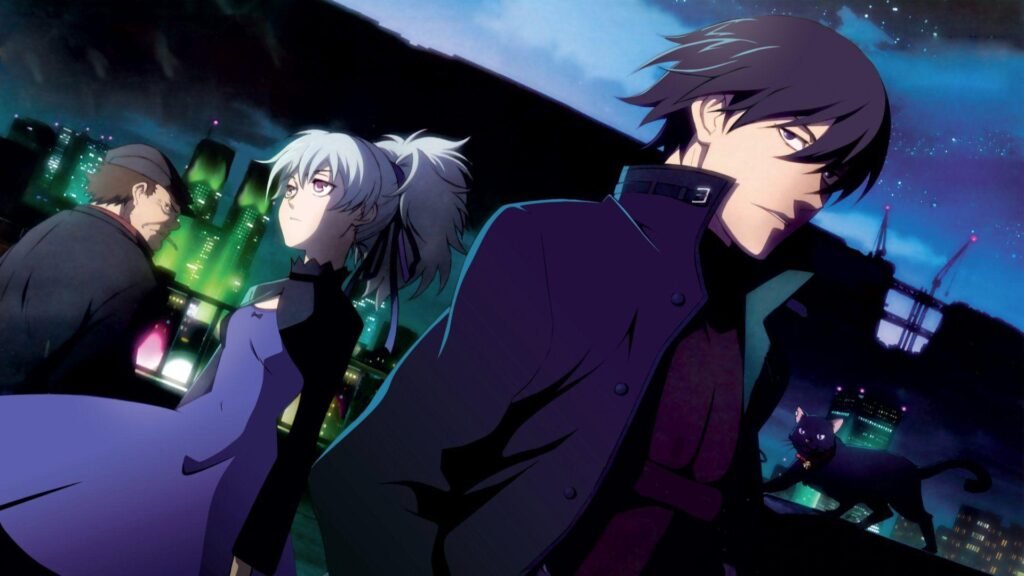
The protagonist is an agent code-named BK-201 who works for an organization called the Syndicate. His real name is Hei. On missions, he’s precise and ruthless. Between missions, he lives in an apartment complex under the name Li Shenshun, a friendly Chinese exchange student who eats huge meals and waves at his neighbors.

In one scene, Li Shenshun is smiling and cooking for someone. Ten minutes later, BK-201 is standing over a body. The show doesn’t transition between the two with dramatic music or visual cues. It just cuts. One scene he’s a person. The next scene he’s a weapon. The show is built around that contrast, and it never tells you which version is the act.

Is the warmth a disguise he built to stay hidden? Or is the cold the disguise, and the person underneath still cares but can’t afford to show it? The show gives you evidence for both readings and never fully commits to either one. Fans who’ve finished the series still argue about it.

How It's Built

Darker Than Black runs in two-episode arcs. Each pair introduces a new set of Contractors, a new situation, and a new piece of a larger puzzle that doesn’t become clear until the final stretch. The show doesn’t explain much upfront. You figure out the rules by watching them in action. The first couple episodes can be confusing because of this. A lot of fans say the show rewards attention once you settle into the rhythm, though not everyone agrees the payoff at the end matches the buildup.

Director Tensai Okamura built it as an original screenplay, not adapted from any manga or novel. That freedom meant the show could be genuinely unpredictable. Characters who seem important don’t survive. Alliances shift without announcement.

Kanno’s score sounds nothing like her Cowboy Bebop or Wolf’s Rain work. Where Bebop was jazz and Wolf’s Rain was orchestral and heavy, Darker Than Black is restrained. Electronic textures. Atmospheric tension. The music sits underneath scenes rather than on top of them. It matches characters whose emotions sit underneath the surface rather than on top of it.

Where It Came From

Okamura also directed Wolf’s Rain at Studio Bones in 2003. He’s said directly that the idea for Darker Than Black came to him during that production. Wolf’s Rain gave him heroes. Kiba and his pack were decent beings trying to find something beautiful in a dying world. Okamura wanted to explore the opposite: characters who were dangerous, emotionally detached, and willing to do terrible things because the mission required it. Darker Than Black is what came out of that question.

Same studio. Same composer. A different kind of character in a different kind of world, built by a director who wanted to explore the opposite of what he’d just finished making.

What Fans Should Know About Darker Than Black Season 2

A sequel, Darker Than Black: Gemini of the Meteor, aired in 2009 for 12 episodes. It changes the protagonist, shifts the tone, and takes the story in a direction that divided the fanbase. Some fans consider it a worthy continuation. Others felt the shift was too jarring from what made Season 1 work. A four-episode OVA set between the two seasons provides connective tissue and is generally well-regarded.

Season 1’s ending left some fans satisfied and others wanting more resolution. Season 2 is a different experience on top of that, and whether it works for you depends on how attached you are to Season 1’s specific tone and structure.

One detail from the production side: a leaked internal document from Bones in 2008 accidentally confirmed both Gemini of the Meteor and Fullmetal Alchemist: Brotherhood were in development before either was officially announced. Bones co-founder Masahiko Minami had to issue a public statement acknowledging the leak.

Did you find Darker Than Black through Bones, through Kanno, through the Wolf’s Rain connection, or completely on your own? Did the Contractor system hook you, or was it Hei’s dual identity? And the question that splits the fanbase: did you watch Season 2, and if you did, did it work for you? We want to hear.

read next

Cowboy Bebop Became the Show Every Anime Fan Recommends to People Who Don't Watch Anime. The Reason It Works Is That It Was Never Really Made for Anime Fans in the First Place.
Wolf's Rain Was the Only Show Cowboy Bebop's Head Writer Ever Created From Scratch.

Leave a Reply

Your email address will not be published. Required fields are marked *