
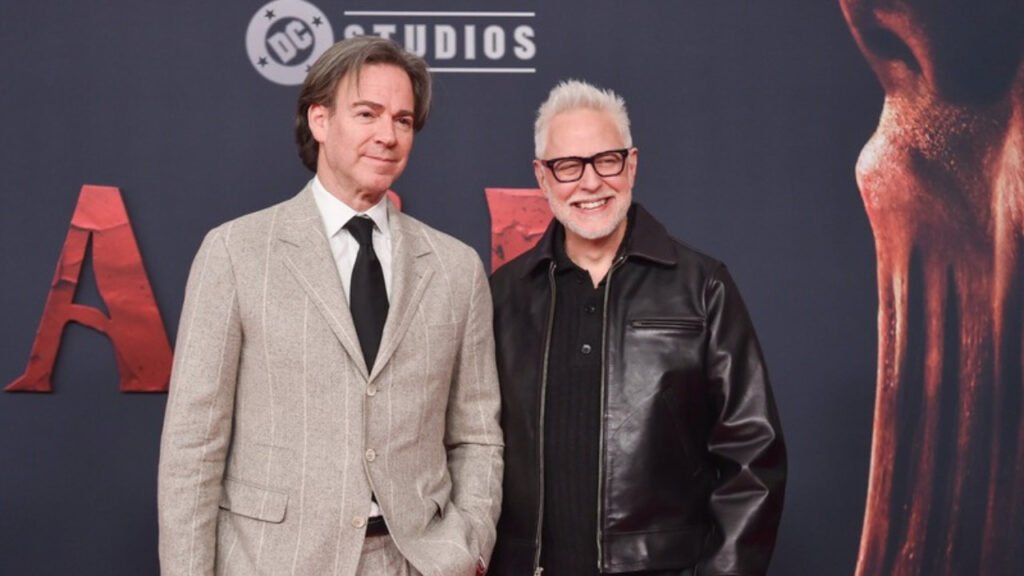
James Gunn Is Leaving DC Studios Leadership. Is the DCU Already Facing Another Identity Crisis?
By Fergs
Four years after Warner Bros. put James Gunn and Peter Safran in charge of rebuilding DC, another executive is taking over. The films are still moving forward. Whether the larger creative plan survives, the transition is a different question.
November 15, 2026
James Gunn and Peter Safran were appointed co-chairmen and co-CEOs of DC Studios in October 2022. Warner Bros. Discovery had spent years trying to build a connected superhero franchise, and the two were brought in to provide something the studio had struggled to maintain: a consistent direction across its films, television series, and animated projects.
On November 9, 2026, Skydance announced that Jeremy Latcham, a former Marvel Studios executive, would replace them as the head of DC Studios beginning December 1. Gunn and Safran will remain involved creatively, including work on Man of Tomorrow, the sequel to Gunn’s 2025 Superman film.
The announcement doesn’t establish why the leadership change was made. It also doesn’t announce another reboot or the cancellation of the DCU’s current slate. What it does confirm is that a studio built around a new creative direction in 2022 will have different executive leadership four years later.
That matters because DC has been through versions of this before. The franchise has changed creative leadership, adjusted its approach to interconnected storytelling, and developed standalone films alongside an evolving shared universe. Some of those decisions produced successful movies. Others left audiences wondering which version of DC they were supposed to be following.
Gunn and Safran were brought in to address that problem. Now the responsibility belongs to someone else, before the first chapter of their planned universe has fully played out.
DC Has Been Trying to Find a Consistent Direction for Years
Warner Bros. began building its modern interconnected DC film universe with Zack Snyder’s Man of Steel in 2013. Batman v Superman: Dawn of Justice followed in 2016, and Justice League arrived in 2017.
The plan developed during a period when Marvel Studios was demonstrating how commercially valuable a connected film franchise could become. By the time Justice League reached theaters, Marvel had already established an extensive network of characters and stories through multiple phases of the MCU.
DC had the characters to build something comparable. Superman, Batman, Wonder Woman, and the Justice League were among the most recognizable properties in entertainment. What Warner Bros. struggled with was how those characters and their films should fit together.
The reception to the early DC Extended Universe films was mixed, and Justice League became a particularly complicated production. Creative changes, reshoots, and disagreements surrounding the film eventually contributed to a larger debate about the direction of the franchise.
Warner Bros. also found success outside its interconnected universe.
Joker arrived in 2019 as a standalone interpretation of the Batman villain. Matt Reeves’ The Batman followed in 2022 with Robert Pattinson playing a different version of Bruce Wayne. Both demonstrated that audiences could respond to DC properties without requiring those films to connect to a larger cinematic universe.
That left the studio operating with different approaches at the same time. The connected universe had its own history, while individual filmmakers were building separate interpretations of some of the same characters.
When Gunn and Safran took over in 2022, their assignment was to organize those properties into a clearer structure.
Their plan introduced an interconnected DC Universe across film, television, and animation, while independent stories such as The Batman would continue under the DC Elseworlds label.
The distinction mattered. It gave the studio a way to build a shared franchise without forcing every successful interpretation of a DC character into the same continuity.
It also gave audiences a more defined understanding of where the franchise was headed.
The question now is how much of that structure will remain unchanged under Latcham. Skydance has not announced that the DCU is being rebooted, and the films currently moving through production remain part of its plans. But a change in leadership can influence decisions long before those changes become visible to audiences.
What the Box Office Actually Shows
The financial performance of DC’s recent films will be a major part of the discussion surrounding Gunn and Safran’s departure.
Gunn’s Superman opened in 2025 and earned more than $618 million worldwide, according to Skydance. It established the new theatrical version of Superman and gave the DCU a successful foundation for its connected film slate.
The following year produced different results.
Supergirl earned approximately $126 million worldwide against a reported production budget of $170 million. Those figures point to a disappointing theatrical performance. The production budget alone exceeded the film’s worldwide box-office gross, before accounting for marketing and other expenses.
Clayface, meanwhile, earned more than $109 million worldwide by the time Skydance announced the leadership change. That figure has to be considered in relation to the film’s smaller production scale rather than compared directly with a blockbuster such as Superman.
Taken together, the three releases show uneven commercial performance. They don’t establish that the entire DCU failed.
They also don’t establish that disappointing ticket sales caused Gunn and Safran to lose their executive positions. Skydance did not identify that as the reason for the transition.
The distinction is important. Box-office totals measure theatrical revenue, not how much a studio ultimately earns from a film. Production costs, marketing expenses, distribution arrangements, and other revenue streams all affect profitability. A film’s commercial results also don’t necessarily tell us whether audiences were satisfied with it.
There is another limitation to judging the franchise this early.
Gunn and Safran’s larger DCU was designed to unfold across multiple movies and television series. The connections between those projects, the development of their characters, and the audience’s investment in the wider story were always going to take time.
Marvel’s early success offers a useful comparison. Iron Man arrived in 2008, but the interconnected structure became more apparent as subsequent films introduced characters who eventually came together in The Avengers in 2012.
That process depended on audiences returning for individual movies while gradually becoming invested in the larger franchise.
DC’s latest universe hasn’t reached an equivalent point. Its early theatrical releases provide evidence of how those individual films performed, but not a complete picture of the long-term strategy.
The unanswered question is whether Skydance believes that strategy needs to change. Nothing in the announcement confirms that it does.
Why Skydance Chose Someone From Marvel
Jeremy Latcham joined Marvel Studios in 2004, before the MCU had become the interconnected franchise audiences know today.
His credits include Iron Man, The Avengers, Guardians of the Galaxy, Avengers: Age of Ultron, and Spider-Man: Homecoming. He also worked with Gunn as an executive producer on Guardians of the Galaxy.
That background makes his appointment significant.
Latcham has experience with the production structure that helped establish Marvel’s early cinematic universe. He worked on films that introduced individual characters, developed them across multiple projects, and eventually brought them together in larger crossover events.
Those are directly relevant experiences for an executive taking responsibility for DC’s film, television, and animation divisions.
His existing relationship with Gunn is another part of the appointment worth considering. The two have worked together before, which could make the transition easier as Gunn continues developing Man of Tomorrow and other creative work.
But Latcham’s appointment also brings DC’s longstanding relationship with Marvel back into the discussion.
Warner Bros. has spent much of the past decade trying to establish a cinematic franchise capable of competing with the MCU. Now a veteran of Marvel’s early development has been selected to oversee that effort.
There is a business case for hiring someone who understands large-scale franchise production. Managing several films and television projects requires coordination between writers, directors, producers, release schedules, and budgets. A studio can have excellent individual projects and still struggle if those projects aren’t supported by a consistent production strategy.
Marvel demonstrated how valuable that coordination could be.
Get the history behind the stories.
Two emails a week. No algorithm deciding whether you see them.
It also demonstrated that the model alone doesn’t guarantee continued success.
The MCU’s interconnected structure worked in part because individual films gave viewers reasons to care about the characters before asking them to follow those characters into larger events. Simply connecting movies together doesn’t reproduce the audience investment that made those connections meaningful.
DC also has storytelling strengths that don’t necessarily resemble Marvel’s.
Batman can sustain a grounded detective story. Superman’s mythology allows for large-scale science fiction and questions about power, responsibility, and humanity. Wonder Woman brings a different set of mythological and historical influences. DC’s larger universe includes generational legacies, alternate worlds, supernatural stories, and characters whose relationships can span decades.
Those properties don’t need an identical storytelling approach to work.
The challenge for Latcham is developing a production structure that supports those differences while giving the larger universe enough consistency to function as a connected franchise.
His Marvel experience may help him do that. What it doesn’t tell us is how he intends to approach DC creatively. Skydance has confirmed his appointment and responsibilities, but a detailed explanation of his long-term strategy has not been established in the announcement.
The Projects That Are Still Moving Forward
The immediate concern for fans is what happens to the films already in development.
Skydance’s November announcement identifies several projects that will continue, including Man of Tomorrow, The Batman Part II, and television projects such as The People v. Gorilla Grodd.
Man of Tomorrow is written and directed by Gunn, with Gunn and Safran producing. It is listed as being in post-production and remains scheduled for July 9, 2027.
The Batman Part II, starring Robert Pattinson, is in production, with Gunn and Safran also attached as producers.
That gives the studio a degree of continuity during the leadership transition. Gunn and Safran may no longer control DC Studios’ overall strategy, but their creative work hasn’t been removed from the projects already underway.
It’s an important difference from a complete creative reset.
There is no confirmation in the announcement that The Batman Part II has been canceled, that Gunn’s Superman storyline is ending, or that the studio intends to abandon the universe introduced under his leadership.
What remains uncertain is how Latcham will approach the projects that haven’t reached production.
As president and chief creative officer, he will have authority over DC’s development, production, talent relationships, and broader creative strategy. Those responsibilities give him influence over which projects move forward and how they fit into the studio’s long-term plans.
He could preserve much of the roadmap Gunn and Safran established. He could also make adjustments to budgets, priorities, release schedules, or the relationship between standalone and interconnected stories.
Both are possible. Neither should be treated as a confirmed plan.
For now, the existing productions tell us more about what is continuing than what might eventually change.
The Leadership Problem Is Older Than James Gunn
Gunn and Safran’s departure can easily be framed as a judgment on their time running DC Studios.
They were hired to rebuild the franchise, and four years later another executive is taking control. Combined with the uneven financial performance of the latest releases, that makes for a straightforward explanation.
It is also an incomplete one.
DC’s difficulties with long-term creative direction existed well before Gunn became co-chairman and co-CEO.
The studio moved from Snyder’s interconnected universe to a mixture of connected and standalone projects, then reorganized around Gunn and Safran’s new DCU. Each approach involved decisions about which characters to prioritize, how much previous continuity should remain, and how closely individual films needed to connect.
Those questions have never had simple answers.
A shared universe can create opportunities for crossovers, recurring characters, and audience investment across several projects. It also introduces dependencies. Changes to one major film can affect plans for others.
Standalone films offer directors more freedom to develop their own interpretations, but they don’t automatically contribute to a larger connected franchise.
DC has experienced both the advantages and complications of those approaches.
The problem isn’t that one model is inherently better. It’s that repeatedly changing the model makes it harder to determine whether the previous strategy would have worked.
There is a financial dimension to that problem.
Skydance controls a collection of DC properties with enormous recognition and commercial potential. Executives are responsible for deciding how much money to invest in those properties and whether their performance justifies that investment.
Those are reasonable business concerns.
But franchise development operates on a longer timeline than a single quarterly earnings report or theatrical release.
Films can spend years moving through development, production, and distribution. Actors and directors may be contracted across multiple projects. Storylines introduced in one installment might not pay off until several years later.
When a studio changes leadership during that process, the incoming executives inherit decisions made under the previous management team. They also gain the authority to reconsider those decisions.
That creates a difficult balance between improving performance and preserving continuity.
Marvel’s first phase lasted from Iron Man in 2008 through The Avengers in 2012. The audience had several years to become familiar with its characters and the connections developing between them.
DC’s new universe was introduced under Gunn and Safran with the expectation that its larger story would unfold over time. Whether that original structure will remain intact under Latcham is still unknown.
What is clear is that DC’s recurring leadership changes complicate the very consistency the studio has repeatedly tried to establish.
What Jeremy Latcham Will Have to Prove
There are reasons Skydance might benefit from this appointment.
Latcham has experience managing films within a connected franchise, understands the production demands of major superhero properties, and has an established professional relationship with Gunn. The continued involvement of Gunn and Safran could also help preserve creative continuity during the transition.
But experience doesn’t eliminate the challenges facing DC.
The studio still needs to demonstrate that its films can attract audiences consistently, that individual projects can succeed on their own merits, and that its larger cinematic universe offers something worth following.
It also needs to decide how much creative independence to give filmmakers working on properties with very different storytelling traditions.
The success of Joker and The Batman demonstrated that standalone interpretations can have considerable commercial and creative value. Gunn’s Superman demonstrated that a new interpretation of a central DC character could also succeed theatrically within a connected universe.
Those results suggest that DC doesn’t have to choose between one approach and the other.
The difficulty is managing both without creating confusion about what the studio is building.
Latcham’s performance will ultimately be measured through the projects released under his leadership, the decisions he makes about future productions, and whether audiences continue returning to DC’s films and television series.
A single appointment can’t answer those questions.
It will take several releases, a sustained creative direction, and enough time for the results to become clear.
DC Doesn't Need Another Beginning
James Gunn and Peter Safran are stepping away from executive leadership, but the universe they helped establish isn’t being formally abandoned.
Man of Tomorrow remains on the schedule. The Batman Part II continues production. Gunn and Safran are still involved with creative projects, and Latcham will take over a studio with films and television series already moving through development.
That gives DC an opportunity to change leadership without immediately discarding the work already completed.
Whether it uses that opportunity is the part we can’t answer yet.
DC has spent more than a decade trying different ways to organize its characters into a successful film franchise. Some of its biggest successes have come from independent filmmakers with distinct interpretations. Other efforts have focused on developing an interconnected universe that audiences can follow over multiple projects.
There is room for both.
What remains difficult is establishing enough consistency that audiences know what to expect from the larger franchise without making every film feel like a required chapter in someone else’s story.
The arrival of a Marvel veteran could provide valuable production experience. It could also produce another shift in priorities. The appointment itself doesn’t establish which outcome is more likely.
For Gunn and Safran, the next chapter will be about continuing their creative work without the same executive responsibilities. For Latcham, it will be about managing a franchise whose history makes another change in direction especially consequential.
And for audiences, the question is much the same one DC has been trying to answer since the beginning of its modern shared universe.
Can the studio commit to a direction long enough to show where it’s going?
A cinematic universe can survive a disappointing movie. It can survive creative disagreements and changes in leadership. What becomes harder to sustain is audience investment when the future of the larger story repeatedly feels uncertain.
DC has already announced several different beginnings. Its next challenge is showing that the stories it starts will have the opportunity to continue.
So where do you stand? Do you see Jeremy Latcham’s appointment as an opportunity to strengthen the DCU, or another leadership change that could interrupt a franchise before its larger story has taken shape?
MORE LIKE THIS
-
Who Is Clayface? Batman’s Saddest Villain Has Been at Least Eight Different People, and the One in October’s Movie Never Existed as a Single Character in the Comics.
5 MIN READ -
5 Comic Book Castings That Changed the Genre Forever. But One Name Didn’t Even Need the List.
6 MIN READ -
Where Do I Start? Marvel and DC Have Been Trying to Answer That Since 2000
7 MIN READ
Co-founder and co-host. Veteran. Strong writer. Sharp eye for the details nobody else notices. Calm voice when the room gets loud. The kind of fan who can quote the scene, name the director, and tell you who else was in the cast without looking it up.