FLCL Is Six Episodes Long. The Director of Avatar: The Last Airbender Ordered His Staff to Watch All of Them.
By Jimigrimm
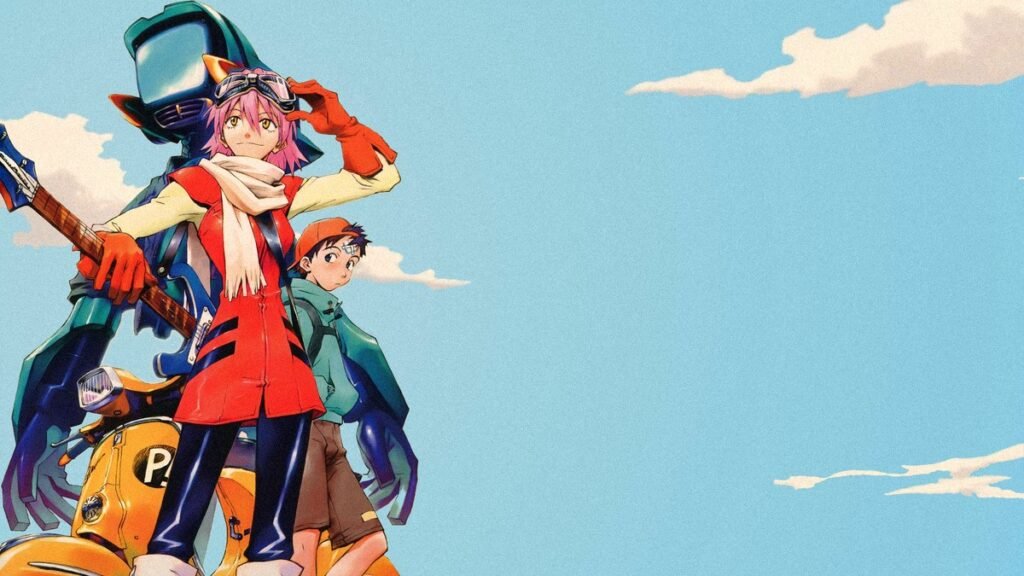
An alien girl on a yellow Vespa runs over a twelve-year-old boy and hits him in the head with a bass guitar. A horn grows out of his forehead. A robot comes out of the horn. The robot starts working at the boy’s family bakery.
That’s the first episode.
If you’ve never watched FLCL, every description of it sounds like someone making things up. The show shifts animation styles mid-scene. Characters break the fourth wall. The plot barely holds together on purpose. The director, Kazuya Tsurumaki, said “comprehension should not be an important factor in FLCL.” He meant it. The show runs on energy, emotion, and music more than it runs on narrative logic, and for the fans who connect with it, that’s enough.
Six episodes. Released as an OVA in Japan from April 2000 to March 2001. Produced by Gainax, Production I.G, and King Records. Premiered on Adult Swim in August 2003. And in that time, it influenced animators and creators who went on to shape both anime and Western animation in ways that are still visible today.
Tsurumaki and Anno
Kazuya Tsurumaki was Hideaki Anno’s protégé at Gainax. He started at the studio as an animation director on Nadia: The Secret of Blue Water in 1990. In 1995, he served as assistant director on Neon Genesis Evangelion. In 1997, he directed Episode 25 of The End of Evangelion, the first half of the film’s conclusion.
FLCL was his directorial debut. And Anno was involved in his own way: he secretly voiced Miyu-Miyu, the cat that appears throughout the series. The credit listed the voice actor as “?” Nobody knew it was Anno until later.
Tsurumaki made a deliberate choice to move in the opposite direction from Evangelion. Where Eva was heavy, psychological, and built on the weight of its characters’ trauma, FLCL is manic, loud, and moves too fast for weight to settle. Both shows are about adolescence. Both are about a boy who doesn’t understand what’s happening to him. But FLCL treats that confusion as comedy and energy rather than despair. Tsurumaki said he wanted to “break the rules” of anime, and the show breaks them constantly: shifting between standard animation, manga panels, paper cutout sequences, and live-action photography without warning.
The Pillows Built the Sound
The entire soundtrack is by The Pillows, a Japanese alternative rock band that had been active since 1989. Tsurumaki chose them for a simple reason: they were his favorite band. “The Pillows are my favorite band, so even before we started production, I contacted them and asked if we could use their music. And they were very willing.”
Using a rock band instead of a composer for an anime soundtrack wasn’t common in 2000. Tsurumaki described patterning the show’s style after “a Japanese TV commercial or promotional video” rather than traditional anime, and The Pillows’ music fit that approach. The songs don’t score scenes the way a traditional soundtrack does. They take over. When “Instant Music” or “Little Busters” or “Ride on Shooting Star” kicks in, the animation matches the music’s energy. The show becomes a music video for a few minutes, and the story keeps moving underneath.
The Pillows’ drummer, Shinichiro Sato, died on March 23, 2026, from esophageal cancer. He was 61. Sato was a founding member of the band from 1989 and played on every FLCL soundtrack across the original OVA, Progressive, Alternative, Grunge, and Shoegaze. The band disbanded in January 2025.
Six Episodes and What They Built
The original FLCL is six episodes totaling roughly two and a half hours. That’s shorter than most films. And the list of creators who have named it as a direct influence is disproportionate to its size.
Giancarlo Volpe, a director on Avatar: The Last Airbender, said his staff was “all ordered to buy FLCL and watch every single episode of it.” Tatsuki Fujimoto, the creator of Chainsaw Man, described his own work as “a wicked version of FLCL.” The show’s willingness to shift animation styles, break tonal rules, and treat visual experimentation as storytelling rather than decoration opened a door that animators on both sides of the Pacific walked through.
FLCL Progressive and FLCL Alternative, two sequel seasons produced by Adult Swim and Production I.G, premiered in 2018. Tsurumaki supervised but did not direct. The Pillows returned. Character designer Yoshiyuki Sadamoto, who also designed the characters for Evangelion, returned. The sequels follow different protagonists in the same world and divided fans between those who felt the original’s energy couldn’t be replicated and those who appreciated the attempt to revisit it from a new angle.
What It Actually Is Underneath
FLCL looks like chaos. It is chaos. But the chaos is built on top of a coming-of-age story about a twelve-year-old boy named Naota who is trying to act like an adult because his older brother left for America and everyone keeps comparing him to the brother who isn’t there. Haruko, the alien who hits him with a guitar, is the disruption that forces him to stop pretending. The robots that come out of his head are the things he’s been keeping inside. The show is about a kid who doesn’t know how to feel what he feels, and every explosion and robot fight and style shift is an externalization of that internal mess.
That’s why the fans who love FLCL love it even when they can’t explain what’s happening on screen. The emotions underneath are specific and real. The twelve-year-old who doesn’t know how to process what’s happening to him is the audience’s way in, and everything else, the aliens, the robots, the government conspiracy, the guitar as a weapon, is the show’s way of making that internal experience visible and loud.
Tsurumaki knew what he was making. The surface is nonsense by design. The coming-of-age story underneath it was not.
Did you find FLCL on Adult Swim, or did someone tell you to watch it and you had no idea what you were getting into? Did the chaos hook you or lose you? And the question that always divides FLCL fans: did the sequels work for you, or does the original six episodes stand alone? We want to hear.