The Woman Who Created Inuyasha Also Created Ranma ½ and Urusei Yatsura. She's Been Publishing Manga Since 1978 and She's Still Going.

Girl falls down a well. Girl ends up in feudal Japan. Girl meets a half-demon pinned to a tree by a sacred arrow. Girl frees the half-demon. A sacred jewel shatters into a hundred pieces. And now they have to find every piece while fighting demons, falling in love, and arguing about it the entire time.

That’s Inuyasha. If you watched it on Adult Swim, you know the formula. What you might not know is that the woman who created it had already been one of the most successful manga creators in the world for over two decades before Inuyasha ever aired.

Rumiko Takahashi

Rumiko Takahashi was born on October 10, 1957, in Niigata, Japan. She published her first professional work in 1978 with a one-shot called Katte na Yatsura, which won the Shogakukan New Comics Award. Later that year, she launched Urusei Yatsura in Weekly Shonen Sunday. She was 20 years old.

Urusei Yatsura ran from 1978 to 1987. Maison Ikkoku, a romantic comedy set in a boarding house, ran alongside it from 1980 to 1987. Takahashi was serializing two hit manga simultaneously in different demographics, one in a shonen magazine and one in a seinen magazine. Urusei Yatsura sold 35 million copies. Maison Ikkoku sold 25 million. She took on two assistants during this period. She deliberately hired women, because she said men would be “too distracting.”

Ranma ½ followed in 1987 and ran until 1996. A martial arts romantic comedy with a gender-swapping twist, it sold over 55 million copies and became one of the most popular manga and anime of the late 1980s and early 1990s.

Then came Inuyasha in 1996. By the time the show premiered on Adult Swim in America, Takahashi had been publishing continuously for 24 years and had already sold over 100 million copies of her previous works.

As of 2024, her total sales exceed 230 million copies worldwide. She was inducted into the Will Eisner Comic Awards Hall of Fame in 2018, the Science Fiction Hall of Fame in 2016, and the Harvey Awards Hall of Fame. She won the Grand Prix de la ville d’Angoulême in 2019, becoming only the second woman and second Japanese artist to win that prize. In 2020, the Japanese government awarded her the Medal with Purple Ribbon. In 2023, France appointed her Chevalier de l’Ordre des Arts et des Lettres. She is still publishing. Her current series, Mao, has been running in Weekly Shonen Sunday since 2019.

What Inuyasha Is

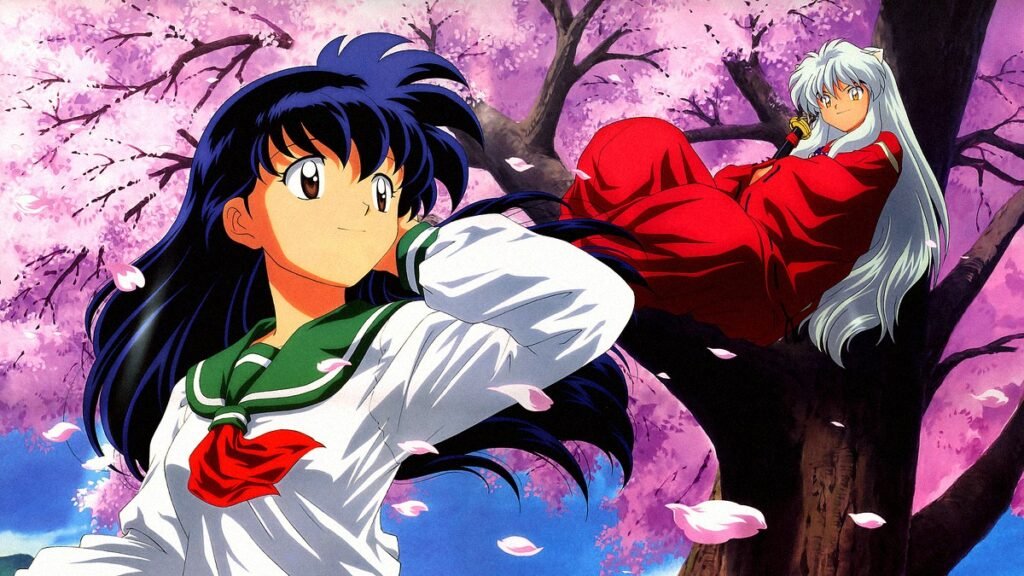
Inuyasha ran in Weekly Shonen Sunday from 1996 to 2008. 558 chapters across 56 volumes. Kagome Higurashi, a 15-year-old from modern-day Tokyo, falls through a well at her family’s shrine and lands in feudal Japan during the Sengoku period. She meets Inuyasha, a half-demon who has been sealed to a tree for fifty years by a sacred arrow. She frees him. The Shikon Jewel, a powerful artifact, shatters into fragments that scatter across Japan. The structure of the series is built around collecting those fragments while fighting the demons who want them.

Underneath the action and the mythology is a romance. Kagome and Inuyasha argue constantly. They protect each other. They get jealous. They almost say what they feel and then don’t. The love triangle with Kikyo, Inuyasha’s previous love who was resurrected from the dead, adds a complication that Takahashi maintained for hundreds of chapters. The show is a shonen action series and a slow-burn romance at the same time, and Takahashi had been writing exactly this kind of genre blend, action wrapped around a relationship the audience can’t look away from, since Urusei Yatsura in 1978.

Adult Swim

The anime adaptation was produced by Sunrise. 167 episodes aired from 2000 to 2004 in Japan. In the United States, Inuyasha premiered on Adult Swim on Saturday nights in 2002. The English dub was produced by Ocean Productions in Vancouver, the same studio that produced the original English dub of Dragon Ball Z. Richard Ian Cox voiced Inuyasha. Moneca Stojka voiced Kagome.

The show ran on Adult Swim from 2002 through 2006. Its audience included fans who had been watching DBZ and Gundam Wing on Toonami and fans who had grown up on Sailor Moon and were now old enough for the late-night block. Inuyasha worked for both groups because it was genuinely both things: action-heavy enough for the shonen audience and emotionally driven enough for the audience that came for the relationships.

The Gap

Inuyasha’s anime ended in 2004 after 167 episodes. The manga continued until 2008. For four years, anime-only fans were left without an ending. The story stopped mid-arc. The final villain, Naraku, was still alive. The jewel was incomplete. Kagome and Inuyasha’s relationship was unresolved.

In 2009, Sunrise confirmed Inuyasha: The Final Act, a 26-episode series that compressed the remaining manga material into a faster, more intense conclusion. Five years after the original anime ended, the story was completed. A sequel series, Yashahime: Princess Half-Demon, ran from 2020 to 2022, following the children of the original cast.

The Sit

There’s a relationship mechanic in Inuyasha that every fan knows. Kagome can say “Sit!” and the enchanted beads around Inuyasha’s neck slam him into the ground. It’s played for comedy throughout the series. It happens dozens of times.

It also tells you something about how Takahashi builds relationships. Inuyasha is physically stronger. He’s a half-demon with superhuman abilities. Kagome is a high school student with a bow. In a fight, she can’t match him. But the beads give her a different kind of authority. When Inuyasha is being stubborn or reckless, one word brings him to the ground. The comedy is real, but the dynamic underneath it, two people constantly negotiating who has power over whom, is the same dynamic Takahashi has been writing since the beginning of her career. Lum shocked Ataru. Akane hit Ranma. Kagome sits Inuyasha. The mechanic changes. The relationship engine stays the same.

That consistency across decades of work is what separates Takahashi from most manga creators. She found a dynamic that works, refined it across five major series spanning nearly fifty years, and each time the audience came back because the fundamental tension, two people who can’t say what they feel and won’t stop trying, kept working across different genres and different decades.

Were you an Inuyasha midnight viewer on Adult Swim? Did you come for the action and stay for the romance, or the other way around? Did you wait for The Final Act, or did you read the manga to find out how it ended? And if Inuyasha was your first Takahashi series, did you go backward and discover Ranma ½ or Urusei Yatsura? We want to hear which door you walked through.

read next

Cowboy Bebop Became the Show Every Anime Fan Recommends to People Who Don't Watch Anime. The Reason It Works Is That It Was Never Really Made for Anime Fans in the First Place.
Tenchi Muyo! Showed Up Between Dragon Ball Z and Gundam Wing and Proved That Anime Could Make You Laugh, Think, and Feel Things You Didn't Sign Up For.

Leave a Reply

Your email address will not be published. Required fields are marked *