
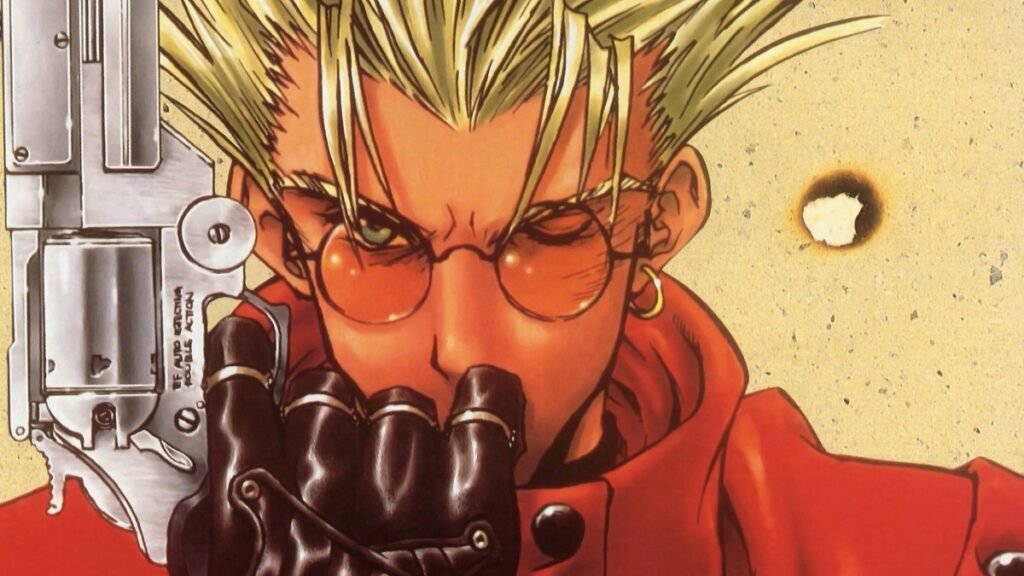
Trigun Was Bigger in America Than It Ever Was in Japan. The Man Who Created It Was Selling Apartments When He Drew the First Page.
By Jimigrimm
You remember the coat. Long, red, impossible. It moved like it had its own personality. You remember the sunglasses and the goofy grin and the way Vash the Stampede would stumble into a town, trip over his own feet, beg for food, flirt with every woman in sight, and make you think he was a complete idiot. And then someone pulled a gun. And the idiot disappeared. And the most dangerous man on the planet showed you exactly why $$60 billion was on his head without killing a single person.
That was the trick. Vash could end every fight in seconds. He chose not to. He chose to take the hits, absorb the damage, protect the people around him, and walk away bleeding while everyone he saved was still breathing. “Love and Peace” wasn’t a catchphrase. It was a philosophy that the entire show tested, bent, and tried to break for 26 episodes straight.
If you watched Trigun on Adult Swim, you were watching one of the only anime in history that was more popular in America than it ever was in Japan. And the story of how it got to your screen is as unlikely as the show itself.
The Apartment Salesman Who Wouldn't Stop Drawing
Yasuhiro Nightow was born in Yokohama in 1967. He grew up on Leiji Matsumoto’s space operas, Rumiko Takahashi’s comedies, and Katsuhiro Otomo’s genre-breaking work. After college, he didn’t go into manga. He went into real estate. He took a job selling apartments for Sekisui House, a housing corporation, and tried to keep drawing on the side. It wasn’t working. The job consumed his time. The manga wasn’t progressing.
He quit. He decided to draw full-time with no safety net, reassured by a few small successes including a one-shot based on the video game Samurai Spirits. With the help of a publisher friend, he submitted a Trigun story to Tokuma Shoten’s Monthly Shonen Captain magazine. It was published in February 1995. A full serialization began two months later.
Nightow had been fascinated by Western movies his entire life. He wanted to build a world that fused the American frontier with science fiction, something he realized had never been done in Japanese manga. But he made one decision that separated Trigun from everything else in the genre: his main character would be a pacifist. Not a reluctant fighter. Not a warrior who felt bad about killing. A man who fundamentally, philosophically, completely refused to take a life, no matter what it cost him. Nightow has said he didn’t want his lead character to be a murderer. In a medium built on escalating combat, he built his hero around the refusal to participate in it.
That decision is the reason Trigun exists. Not the guns. Not the desert planet. Not the bounty. The tension between Vash’s power and his refusal to use it fully is the engine that drives every episode. Take that away and Trigun is just another space Western. Leave it in and the show becomes a 26-episode argument about whether mercy is strength or weakness, and whether one person’s refusal to kill can survive a world that demands blood at every turn.
The Magazine Died. Trigun Almost Died With It.
Shonen Captain, the magazine serializing Trigun, ceased publication in 1997. The magazine didn’t cancel Trigun. The magazine itself stopped existing. Everything in it was gone. Trigun’s home vanished mid-story, with the narrative unfinished and no publisher to carry it forward.
A new publisher, Shonen Gahosha, approached Nightow. They wanted him to start something new for their magazine Young King OURs. Nightow refused. He told them he couldn’t leave Trigun incomplete. He asked to be allowed to finish the story he’d started. The publishers agreed. Trigun resumed under the new title Trigun Maximum and ran from 1997 all the way to 2007. Nightow has said the name change was purely because of the publisher switch, not a reboot or a sequel. It was the same story, continued by an artist who wouldn’t let it die.
That stubbornness matters. Most manga creators in that situation would have moved on. A dead magazine is a dead magazine. Starting fresh with a new publisher on a new property is the safer play. Nightow chose the harder path because the story wasn’t finished yet. Trigun Maximum ran for 14 volumes and ten years because one person decided the work mattered more than the business logic.
Get the history behind the stories.
One email a week. Read it before it hits the feeds.
The Anime Outran the Manga
Madhouse Studios adapted Trigun into a 26-episode anime that aired on TV Tokyo from April to September 1998. Satoshi Nishimura directed. Yosuke Kuroda wrote the scripts. Tsuneo Imahori composed a soundtrack that sounded like electric guitars dragged across a desert.
But there was a problem. By the time the anime reached episode 16, it had caught up to the manga. Nightow was still writing Trigun Maximum. The source material simply didn’t exist yet for the back half of the show. So from episode 16 onward, the anime tells a different version of the story than the manga eventually would. Nightow worked with the Madhouse team, creating characters and plot elements specifically for the anime that were never used in the manga. The two versions of Trigun share a beginning and a cast but diverge into separate stories halfway through.
That means every fan who watched the anime and then read the manga discovered a different Trigun. The characters are the same. The world is the same. The heart is the same. But the events, the villains, and the resolution are different. Most anime adaptations either follow the manga faithfully or get criticized for deviating. Trigun’s anime deviation was born out of necessity, and Nightow himself called the adaptation faithful to the spirit of the work even as it departed from the plot. He credited the anime with helping him properly serialize the story, because seeing his characters animated clarified things about them that he hadn’t fully realized on the page.
Modest in Japan. Massive in America.
Here’s the detail that reframes everything about Trigun’s legacy.
The anime underperformed in Japan. It aired on TV Tokyo in 1998 and didn’t break through the way other shows in the same time period did. The manga had a following, but the anime never became a hit in its home country. Trigun was, by Japanese market standards, a modest property at best.
Then Adult Swim picked it up. The English dub, produced by Animaze and distributed by Pioneer Entertainment, premiered on Cartoon Network’s late-night block on March 31, 2003. It aired alongside Cowboy Bebop, another space-adjacent anime with a cult following. And Trigun exploded.
America gave Trigun the audience Japan never did. The show became one of the most popular anime in the United States, building a fanbase that was larger and more passionate than anything it had achieved at home. The first American print run of the Dark Horse manga translation, 30,000 copies, sold out in two to three days. A 15,000-copy reprint went to press immediately. Nightow himself, speaking at Tokyo Comic-Con, said: “When I go abroad, I’m surprised that even people who aren’t anime fans know about it. It was broadcast on Cartoon Network in the U.S. at just the right time, and from there it spread and led me to so many places.”
This almost never happens. Most anime finds its audience in Japan first and then crosses over to the West. Dragon Ball Z was massive in Japan before Toonami made it massive in America. Cowboy Bebop was critically acclaimed in Japan before Adult Swim gave it a second life. Trigun is one of the rare exceptions: an anime that was modest at home and became a phenomenon because an audience its creator never expected to reach showed up and made it theirs.
The Man Behind the Coat
Nightow has been open about what creating Trigun cost him. He described the process as “drawing while teetering on the brink of death.” He said: “Every time, what was difficult? Everything!” He once submitted a finished manuscript on the morning of the day he was supposed to fly to Comic-Con in America, then immediately boarded an international flight. The image of a manga artist finishing pages at dawn and sprinting to an airport is the kind of detail that makes you understand what it takes to keep a story alive when every system around it is trying to let it die.
He also built details into Trigun that fans have been unpacking for decades. The name “Trigun” comes from Vash’s three weapons: his revolver, his prosthetic arm gun, and his supernatural Angel Arm. Spider-Man was a major influence on Nightow’s work. The villain Monev the Gale is “Venom” spelled backwards. Wolfwood’s name was taken from a rock musician, and his visual design was modeled on Tortoise Matsumoto from the band Ulfuls. The small black cat that appears in every single episode, Kuroneko-sama, originated in one of Nightow’s earliest manga and became a signature Easter egg across the entire franchise.
These aren’t random trivia. They’re evidence of a creator who poured everything he had into a world that kept nearly disappearing. The magazine died. The anime underperformed. The story split in two. And through all of it, Nightow kept drawing, kept building, kept refusing to let Trigun end before it was ready.
The Return
Trigun Stampede premiered in January 2023, produced by studio Orange using full CG animation. It was a ground-up reimagining, not a continuation. New visual style. New pacing. New interpretation of the characters. The fan reaction was split: some embraced the reimagining, others missed the Madhouse aesthetic and the tonal balance of the original. Trigun Stargaze, the sequel to Stampede, premiered in January 2026 and expanded the story beyond anything the original anime or manga had attempted.
The franchise that was created by an apartment salesman, published in a magazine that died, adapted into an anime that couldn’t find its audience at home, and became a phenomenon on a late-night American cartoon block is still telling stories three decades later. That doesn’t happen because of luck. That happens because Yasuhiro Nightow made a decision in 1997, when his magazine collapsed and a new publisher wanted something different, to finish what he started. And because a few years later, an audience on the other side of the planet proved him right.
When did you first meet Vash? Was it on Adult Swim at midnight, half-awake on a school night? Was it a friend’s recommendation? A DVD borrowed and never returned? And the question that separates Trigun fans from everyone else: when did the show stop being funny and start being something else entirely? Because every Trigun fan knows the exact episode where Vash stopped smiling and the show asked you to carry something heavier than you signed up for. Which episode was yours? We want to hear the moment Trigun got real for you.
MORE LIKE THIS
-
Wolf’s Rain Was the Only Show Cowboy Bebop’s Head Writer Ever Created From Scratch.
5 MIN READ -
The Big O Was Cancelled in Japan After 13 Episodes. It Was So Popular in America That Cartoon Network Helped Fund the Other Half.
6 MIN READ -
Attack on Titan Was Rejected for Being Too Dark. The Teenager Who Created It Refused to Change It. It Crossed Into the Prestige-TV Mainstream That Anime Almost Never Reaches.
7 MIN READ

Co-founder and co-host. Veteran. Grew up on cartoons. The MCU brought all of it back and pulled him into the comics side he never picked up as a kid. Curious by default. Passionate without needing to prove anything. Good at holding a conversation.