Why Does Marvel Kill Characters and Bring Them Back? The Real History of How Death Stopped Meaning Anything in Comics.

You’ve seen it happen. A character you care about dies. The story commits to it. The funeral happens. The other characters grieve. You grieve. And then, six months later, maybe a year, maybe five years, the character is back. Different body. Different timeline. Cloned. Resurrected. Retconned. The explanation doesn’t matter because the result is always the same: the death you felt was permanent wasn’t, and the next time a character dies, you feel a little less.

That cycle, the one where you know the death won’t stick but you’re supposed to feel something anyway, didn’t always exist. There was a specific moment when death in comics went from permanent to temporary, and once that door opened, it never closed.

Before 1980, Major Characters Didn't Die

This sounds obvious but it’s important to understand how different comics were before the moment that changed everything. Characters got hurt. They got captured. They faced impossible odds. But the major heroes and their supporting cast didn’t die. The medium operated on an unspoken rule: the characters are the product, and you don’t destroy the product. Uncle Ben died because his death defined Spider-Man. Gwen Stacy died because her death redefined what comics were willing to do. But those were supporting characters whose deaths served the hero’s story. The heroes themselves were untouchable.

That changed in 1980.

The Death That Was Supposed to Mean Something

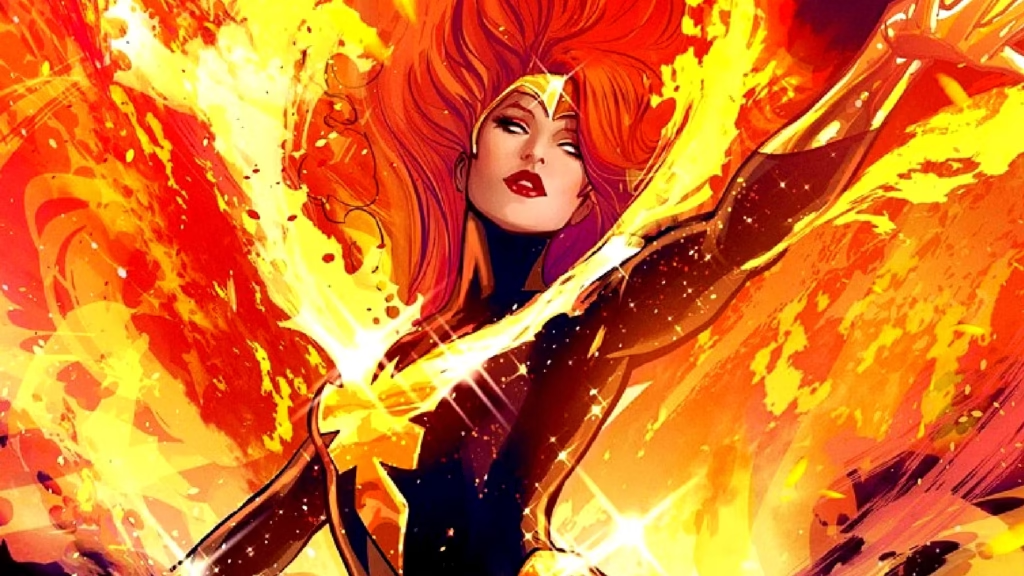
Uncanny X-Men #137, written by Chris Claremont and drawn by John Byrne, killed Jean Grey. The Dark Phoenix, a cosmic entity that had merged with Jean, destroyed an inhabited star system and killed billions. Marvel’s editor-in-chief Jim Shooter reviewed the story and made a decision: a character who committed genocide could not simply be depowered and released. There had to be consequences. Claremont and Byrne rewrote the ending. Jean activated an ancient weapon on the Moon and killed herself rather than risk the Dark Phoenix returning.

It was one of the most significant moments in comic book history. A founding member of the X-Men, a character who had been in the book since 1963, was dead. Not captured. Not transported to another dimension. Dead. Self-inflicted. On the Moon. With the entire team watching.

For five years, that death held. Jean Grey was dead. The X-Men mourned her. The stories moved forward without her. Readers accepted that this was permanent because it had never happened before at this level. If a founding X-Man could die and stay dead, then death in comics meant something.

The Fan Who Undid It

Kurt Busiek was a young comic book fan who had just started freelancing as a writer in the early 1980s. He loved the original X-Men. He didn’t want Jean Grey to stay dead. So he came up with a solution: what if Jean was never the Phoenix? What if the Phoenix Force had created a duplicate of Jean, copied her mind and memories, and the real Jean had been in a cocoon at the bottom of Jamaica Bay the entire time?

Busiek shared this idea with his friend Roger Stern. Stern mentioned it to John Byrne, who was writing Fantastic Four at the time. Byrne passed it to Marvel. Bob Layton, who was developing a new series called X-Factor that would reunite the original five X-Men, needed a fifth member. Dazzler was the original choice. When Byrne’s pitch arrived, Marvel chose Jean instead.

In January 1986, Fantastic Four #286 brought Jean Grey back. The cocoon was found. Jean emerged. The Phoenix had never been her. Five years of meaningful death were retroactively erased by a fan’s clever workaround that a writer passed to an artist who passed it to an editor who needed a character for a new book.

Chris Claremont, who had written Jean’s death, was furious. He said in 2012: “We’d just gone to all the effort of saying, ‘Jean is dead, get over it,’ and they said, ‘Haha, we fibbed.’ So why should anyone trust us again?”

That question, “why should anyone trust us again,” is the question the entire comics industry has been failing to answer for 40 years.

The Floodgates

Jean Grey’s return didn’t just bring back one character. It established a precedent: death in comics is reversible. Once that precedent existed, every subsequent death was measured against it. If Jean Grey could come back, why not anyone?

Superman died in 1992. Massive cultural event. International news coverage. The issue sold millions of copies. He was back within a year. Captain America was assassinated in 2007. He was back by 2009. Batman died in Final Crisis in 2008. He was revealed to be lost in time and returned in 2010. Wolverine died in 2014’s aptly named Death of Wolverine. He was back by 2018. Each death was marketed as permanent. Each return was treated as an event. Each cycle made the next death less impactful.

The pattern created its own language. Fans started saying “no one stays dead in comics except Bucky, Jason Todd, and Uncle Ben.” Then Bucky came back as the Winter Soldier in 2005. Then Jason Todd came back as the Red Hood in 2005. Uncle Ben remains the last holdout, and fans joke that even he’s not safe.

Why They Keep Doing It

The business reason is straightforward. A character’s death generates a sales spike. The issue where Spider-Man dies, where Wolverine dies, where Captain America dies, outsells the issues around it by significant margins. The return generates another sales spike. The #1 issue of the returning character’s new series outsells everything. Death and resurrection is a two-part sales event, and both parts work commercially even though both parts erode the audience’s trust in the stakes of the stories being told.

The creative reason is more complicated. Writers want to tell stories with consequences. Editors approve those stories. But the characters are corporate-owned intellectual property worth billions in licensing, merchandise, and film rights. A dead character doesn’t sell action figures. A dead character doesn’t star in movies. The business will always override the story, and the business says the character comes back.

This is the fundamental tension that defines death in superhero comics: the people writing the stories want death to matter, and the people who own the characters need death to be temporary. Neither side is wrong. And the result is a medium where every death is simultaneously meaningful within the story and meaningless within the larger publishing history.

What It Did to the Audience

The real cost isn’t creative. It’s emotional. When a character dies in a comic book or a comic book movie, the audience’s first response is no longer grief. It’s calculation. “Will they bring this character back? How long until the return? Is this a real death or a fake death?” The audience has been trained by 40 years of reversals to treat every death as a puzzle to solve rather than a loss to feel.

That’s why Avengers: Endgame hit so hard. Tony Stark’s death felt permanent because Robert Downey Jr.’s contract was ending and the actor appeared to be done with the role. The audience believed it because the business circumstances supported it, not because the story earned a level of trust the medium has spent decades destroying. And now RDJ is back as Doctor Doom, which means even the MCU’s most trusted death is being complicated by the return of the face that died.

The medium that invented the modern superhero also invented the modern audience’s inability to trust a character’s death. Every time a writer kills a character and means it, they’re fighting against 40 years of precedent set by a young fan’s clever idea, a writer who needed a fifth team member, and an industry that learned it could sell the same death twice.

When was the last time a character death actually surprised you? Not the death itself, but the fact that it stuck? Was it Logan in 2017? Tony Stark in 2019? Someone from the comics you thought was really gone? And the harder question: does the revolving door make you care less, or have you made your peace with it? We want to hear where you are with death in comics, because everyone’s threshold is different.

read next

Marvel Just Lost the Team That Designed the Way the MCU Looks. The Real Story Behind Why It Happened Is Bigger Than Marvel.
The MCU Was Built on Characters Nobody Wanted. The Ones Marvel Sold Off Were the Popular Ones.

Leave a Reply

Your email address will not be published. Required fields are marked *