Gungrave Launched as a Game and an Anime at the Same Time. Only One of Them Became a Tragedy People Never Forgot.

In 2002, Gungrave arrived as a whole package at once. A PlayStation 2 game, an anime, and a manga, a brand-new property from Yasuhiro Nightow, the creator of Trigun, with mechanical designs by Kosuke Fujishima and a score by Tsuneo Imahori, who had just scored Trigun. Sega thought enough of it to take a majority stake in the studio behind it and publish the game in the West. This was a high-profile launch, not a forgotten one.

The game was a stylish third-person shooter. Reviewers liked the look and the attitude, and found the shooting itself fun but shallow, a good-looking arcade blast that was more about style than depth. It did its job.

But here is the thing about a media mix built around one new idea: the pieces do not all reach the same depth. The game gave you a resurrected gunman mowing down a syndicate for revenge. The anime, made at Madhouse in 2003, took that same world and went somewhere the game never tried to go. It became a tragedy about two friends that is now regularly named one of the best video-game-connected anime ever made. It is the piece of Gungrave that lasted, the one fans still press into each other’s hands twenty years later.

The Choice That Made It Hurt

Here is the move. The anime didn’t try to put the shooting on screen. It told the story underneath it. The first episode opens in the present, on the resurrected gunman. Then the show stops and goes back, spending roughly the next fifteen episodes on a long flashback to decades earlier, showing two street kids growing up together before any of the killing started.

That is a bold choice for an action property. The game was about style and motion. The anime spends more than half its run not shooting, just building two people you are going to watch destroy each other. Brandon Heat, quiet and loyal, who only wants to protect the people he loves. Harry MacDowell, his best friend since they were broke kids stealing to eat, who is funny and magnetic and slowly eaten alive by ambition.

In the game, the story was mostly a frame for the action. The anime gave Brandon and Harry inner lives. Brandon barely talks, so they gave him an internal world and made his silence mean something. Harry could have been a cackling villain, and instead he became the most tragic character in the show, a man clawing for the top who loses the one person who actually loved him to get there. By the time the betrayal comes, you have spent fifteen episodes watching these two be brothers. So when it lands, it does not feel like a plot point. It feels like a death in your own life.

What It Is Actually About

Brandon and Harry grow up on the street in a poor part of the city with a small crew of friends. After their friends are killed, the two of them join Millenion, the mafia that runs everything, both swearing to climb the ranks and protect what they have left.

Their paths split. Brandon becomes the most feared enforcer in the organization, the “sweeper,” but everything he does is to protect the people he cares about, Harry, their boss Big Daddy, and Maria, the only woman he ever loved. Harry wants the top, and he wants it badly enough to do the one thing you cannot come back from. He has Brandon killed.

Years later Brandon is brought back from the dead as a gunman called Beyond the Grave, and he comes for the organization and the man who betrayed him. But the revenge is not the point. The point is everything you watched before it. Gungrave is not a story about a guy with guns. It is a story about a friendship, and what ambition does to the people who swore they would never let anything come between them.

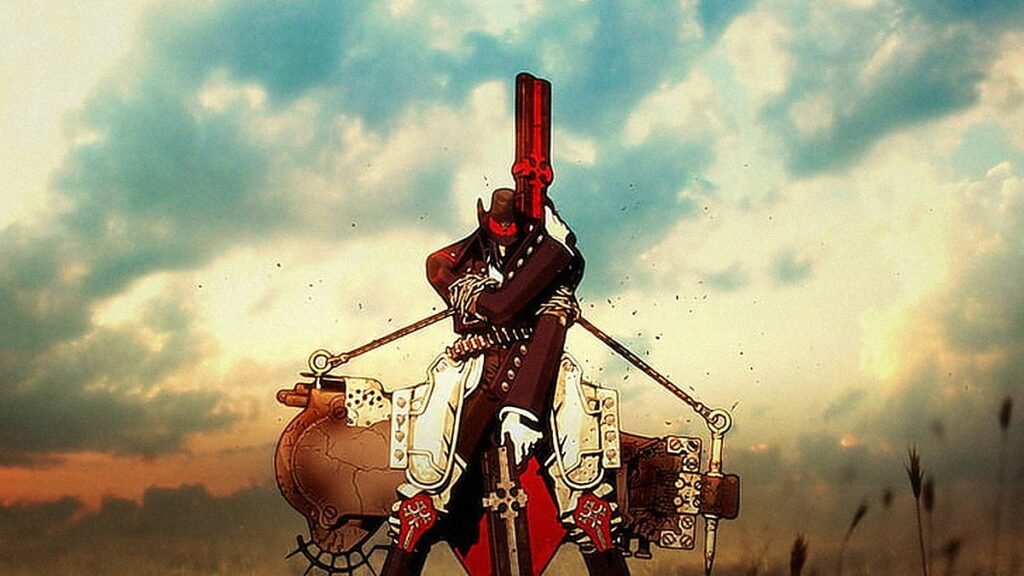
The composer was Tsuneo Imahori, who also scored Trigun, and the character designs came from Yasuhiro Nightow himself, the Trigun creator who built Gungrave’s original concept. So if Brandon’s coat and silhouette and the whole melancholy-gunslinger mood feel familiar, that is why. Same hands.

Why the Anime Is the Part That Lasted

There is a lesson in Gungrave that is bigger than the show.

When a property launches as a media mix, a game and an anime and a manga all at once, the pieces split the work. The game carried the style and the action. The anime carried the heart. Madhouse took the same characters and the same world and asked a different question: not how do we make this fun to play, but what makes these two men matter. They built the whole thing around the friendship and the betrayal, and let everything else fall away.

That is why the anime is the piece people still pass around. The game gave you a reason to shoot. The anime gave you a reason to care, and then made you watch it fall apart. Plenty of fans who played the game will tell you the anime is the deeper work, and plenty of people who would never pick up the game found the anime anyway and never forgot it. Same world, same bones, but the anime went somewhere the game was never trying to go.

It came out in the same crowded era as the shows everyone still names first, and it never got the lasting spotlight some of them did. But it quietly turned out to be one of the best things Madhouse made in that whole run, and the people who have seen it guard it like a secret.

So here is what we want to know. Did you find Gungrave back when it aired, or did someone have to drag you to it past the “it’s connected to a game” reflex? Were you a Brandon or did you understand Harry more than you wanted to admit? And the question that matters most for this one: which episode was it for you, the one where you realized this was not an action show at all and you were about to get your heart broken? Tell us when Gungrave stopped being what you thought it was.

read next

Trigun Was Bigger in America Than It Ever Was in Japan. The Man Who Created It Was Selling Apartments When He Drew the First Page.
Cowboy Bebop's Own Sponsor Tried to Kill It Halfway Through Production

Leave a Reply

Your email address will not be published. Required fields are marked *