
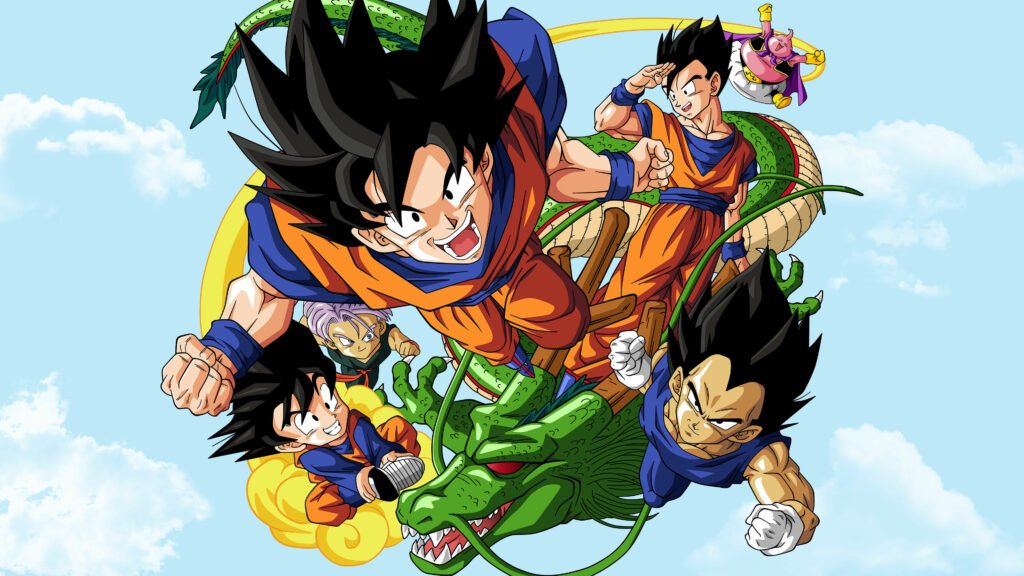
Dragon Ball Z Was Cancelled Twice in America Before Toonami Turned It Into the Biggest Anime on the Planet.
By Jimigrimm
You already know the Spirit Bomb takes three episodes. You know this because you watched it happen, came back the next day, watched Goku still charging it, came back the day after that, and he was STILL charging it. And you came back again. Every single time. Because there was nothing else on American television that made you feel the way Dragon Ball Z did, and you weren’t going to miss the moment it finally landed.
That show, the one that had you sprinting home after school to catch the 4 o’clock Toonami block, the one where you learned what a Super Saiyan was before you learned what anime was, the one that made you genuinely angry when your mom called you to dinner during a fight scene, was not supposed to exist in your life.
It had already finished airing in Japan before you ever heard of it. All 291 episodes ran on Fuji TV between April 1989 and January 1996. By the time America got it, Dragon Ball GT was already running in Japan. And the first two attempts to bring DBZ to the West failed so badly that the show was literally cancelled. Twice.
The First Death
Funimation licensed Dragon Ball Z in 1995 after their dub of the original Dragon Ball went nowhere. They partnered with Saban Entertainment, the company behind Power Rangers, to handle distribution. Saban hired Ocean Studios in Vancouver to dub the anime and brought in composer Ron Wasserman to create the “Rock the Dragon” theme. The first 67 Japanese episodes were cut to 53 for American broadcast.
Saban’s censorship was ruthless. Every reference to death was removed. Characters who died were sent to “another dimension.” Hell became “H.F.I.L.”, the “Home For Infinite Losers.” Scenes of young Gohan crying were digitally altered to erase his tears because Saban’s guidelines prohibited showing children in distress. Blood was painted over frame by frame.
The show premiered in U.S. syndication on September 13, 1996. Syndication meant local stations could air it whenever they wanted. No consistent time slot. No guaranteed channel. Episodes airing out of order on random networks across the country. A serialized story that required you to watch every episode in sequence was being treated like a cartoon you could drop into at any point.
It was cancelled after two seasons in May 1998. Saban scaled down syndication to focus on original Fox programming. The dub stopped cold in the middle of the Namek saga. Fans were left on a cliffhanger. Pioneer Entertainment stopped releasing VHS tapes. Dragon Ball Z was dead in America.
The Resurrection
On August 31, 1998, three months after cancellation, reruns of those same 53 Ocean-dubbed episodes started airing on Cartoon Network’s Toonami block. Same censored episodes. Same “Rock the Dragon” opening. The only thing that changed was the delivery. Same time. Same channel. Every day. Episodes in order.
Dragon Ball Z became the highest-rated show on Toonami almost immediately.
But there were only 53 episodes. The show looped. And looped. And looped. Fans watched the Saiyan saga and the first half of the Namek saga over and over, waiting for the story to continue past the point where the cancelled dub had left them hanging. “Will Goku ever get to Namek?” wasn’t just a joke in the community. It was a genuine question nobody had an answer to.
Get the history behind the stories.
One email a week. Read it before it hits the feeds.
The “It’s over 9,000!” line that became one of the first anime memes in internet history came from those 53 episodes. In the original Japanese, Vegeta says Goku’s power level is over 8,000. The Ocean dub changed it to 9,000. A deliberate localization choice in a cancelled dub of a show airing in reruns on an afternoon cartoon block became one of the most recognizable lines in anime history. That’s how deep those 53 episodes cut.
Funimation Had to Start Over From Nothing
The Toonami reruns proved the audience existed. Funimation decided to resume production. But Saban was gone, and without Saban’s money, Funimation couldn’t afford Ocean Studios.
They built a new operation from scratch at their studio in Texas. And the man who became the voice of Goku for the next 27 years got the job almost by accident. Sean Schemmel was a trained classical French horn player who had never done professional voice acting. A friend talked him into auditioning. He tried out for Captain Ginyu, a minor villain. He didn’t get that role. Instead, Funimation had him recording for two weeks before anyone told him he was voicing the lead character in the entire franchise. The cast was instructed to mimic the original Ocean actors. Schemmel was good at mimicry, but over time he made Goku entirely his own.
Chris Sabat, who took over as Vegeta, ended up voicing over a dozen characters across the franchise because Funimation couldn’t afford a bigger cast. Vegeta, Piccolo, Yamcha, Kami, Mr. Popo, Korin, Burter, Recoome, Jeice, Shenron, and more. One actor, switching between heroes, villains, gods, and dragons in the same recording sessions because the budget demanded it. That’s how thin the operation was. Bruce Faulconer replaced the Saban score with a new synthesizer-heavy soundtrack that would become as iconic as the show itself. Half the fanbase loved it. The other half mourned “Rock the Dragon.” That debate is still going in 2026.
Schemmel has spoken about what it meant to carry the role. In one interview, he said he was going to treat Goku the way any actor would treat a defining role and give his whole life and soul to it. He’s passed out in the recording booth screaming Super Saiyan transformations. He’s been voicing Goku in every Dragon Ball anime, movie, and video game for over a quarter century. A classical musician who walked into an open audition and accidentally became the voice of the most famous character in anime.
New episodes premiered on Toonami on September 13, 1999. Without Saban, the censorship loosened. Characters could say “die.” The editing was less aggressive. The show still wasn’t uncut for the afternoon block, but it was closer to the original than the first 53 episodes had ever been. New episodes ran on Toonami from 1999 through April 2003.
The Show That Built the Block
When Anime News Network reported on Gundam Wing’s Toonami debut in March 2000, they noted it was beating Dragon Ball Z in all age categories. That detail matters because it means DBZ had competition on its own block and STILL maintained its position as the anchor. Gundam Wing’s ratings were remarkable precisely because they were measured against DBZ, the show that had set the bar.
Every anime that followed DBZ onto Toonami benefited from the audience it built. Gundam Wing got a 5:30 slot right after DBZ, guaranteeing that fans who tuned in for Goku would stick around for Heero Yuy. The Midnight Run, Toonami’s late-night block that aired uncut anime including an uncensored Gundam Wing, existed because DBZ’s ratings proved older audiences were watching. Jason DeMarco, Toonami’s co-creator, has said that Adult Swim’s action block wouldn’t have been possible if Cartoon Network hadn’t already known there was an older audience out there. DBZ’s Toonami success didn’t just build Toonami. It built the infrastructure that brought anime to American adults.
The Legacy Isn't the Sequels. It's the Infrastructure.
There’s a moment in the Cell Games saga where Goku turns to Gohan, his son, and tells him he’s the one who has to finish this fight. Not Goku. Not Vegeta. Not Piccolo. The kid. And if you watched it on Toonami, you remember the silence in your living room when Gohan powered up, the screen went white, and the lightning cracked. You remember the Faulconer score swelling underneath it. You remember knowing, for the first time while watching a cartoon on an American television, that this story was willing to make its hero step aside and trust someone else to carry the weight. Nothing on Western TV was doing that. Nothing on Western TV was close.
That’s the moment Dragon Ball Z stopped being a show you watched and became a show that changed what you expected from everything else.
Dragon Ball Z has sold over 260 million manga volumes worldwide. Dragon Ball Super, Daima, and new projects keep the franchise alive. But the real legacy of DBZ on Toonami isn’t the franchise continuing. It’s what the show’s success made possible for everyone else.
Funimation grew from a scrappy Texas startup that couldn’t afford its own voice cast into the largest anime distributor in North America, largely on DBZ revenue. Toonami became THE destination for anime in America because DBZ proved the model worked. Adult Swim exists because DBZ proved the audience stayed up late. Every anime fan who watches Crunchyroll in 2026 is downstream of the moment those 53 cancelled episodes started airing in reruns on August 31, 1998.
Akira Toriyama, who created Dragon Ball, passed away in March 2024. Toonami honored him with a special four-hour Dragon Ball Z Kai marathon on March 16. Steve Blum, the voice of TOM, introduced the tribute. A man who started drawing a manga about a monkey-tailed boy in a Japanese magazine in 1984 was being memorialized on the same American television block where millions of kids first learned his name without ever knowing it. Every kid who came home from school and watched Goku fight on Toonami was experiencing Toriyama’s imagination. Most of them didn’t learn his name until the day he was gone.
The biggest anime in America was cancelled. Twice. A trained French horn player accidentally became the voice of its hero. A programming block that hadn’t figured out what it wanted to be yet gave it a home. And from that chain of accidents came the foundation for everything anime would become in the West.
Do you remember the first Dragon Ball Z moment that got you? Not the first episode. The moment. Was it Goku going Super Saiyan for the first time on Namek? Gohan snapping against Cell? Vegeta’s sacrifice against Buu? The moment you realized this show wasn’t playing by the same rules as anything else on American TV? We want to hear which one is yours.
MORE LIKE THIS
-
Tenchi Muyo! Showed Up Between Dragon Ball Z and Gundam Wing and Proved That Anime Could Make You Laugh, Think, and Feel Things You Didn’t Sign Up For.
5 MIN READ -
The Big O Was Cancelled in Japan After 13 Episodes. It Was So Popular in America That Cartoon Network Helped Fund the Other Half.
6 MIN READ -
Yu Yu Hakusho Was Created by a Man It Nearly Broke. It Became One of the Greatest Anime to Ever Air on Toonami.
6 MIN READ
Co-founder and co-host. Veteran. Grew up on cartoons. The MCU brought all of it back and pulled him into the comics side he never picked up as a kid. Curious by default. Passionate without needing to prove anything. Good at holding a conversation.