
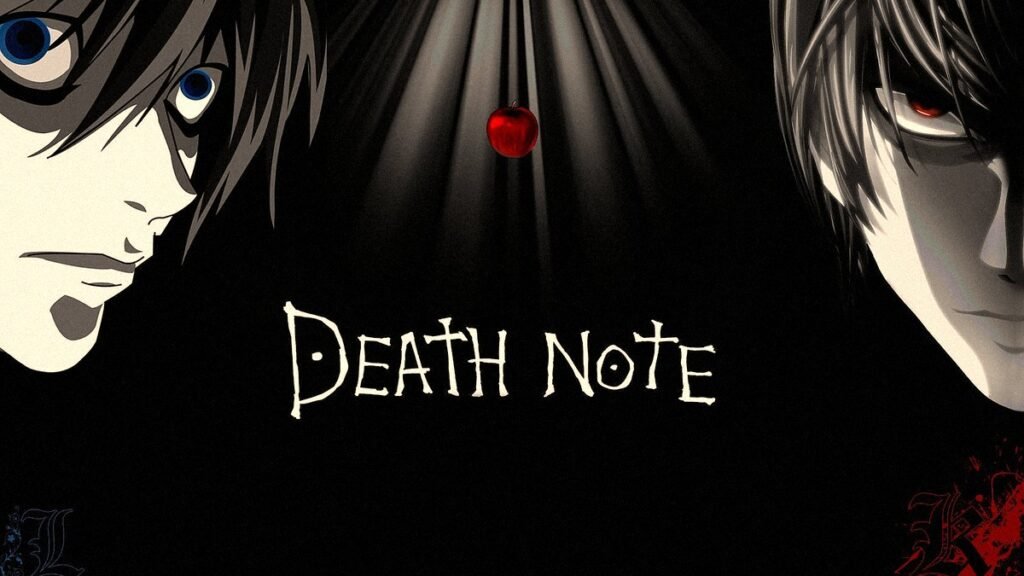
Death Note Was Built Around a Single Question: Would You Root for the Villain?
By Jimigrimm
Light Yagami writes a name in a notebook. Someone dies. The show presents his reasoning so logically, so calmly, so convincingly, that his justification for murder starts to feel reasonable before most viewers realize what’s happened. He’s only killing criminals. The world is getting safer. The system wasn’t working. He’s making it work.
That’s how Death Note hooks its audience. Not with action. Not with spectacle. With a moral compromise so elegantly presented that the line between rooting for justice and rooting for a mass murderer disappears before the viewer has a chance to notice. The show never tells you Light is right. But it presents his logic so effectively that resisting it takes effort.
Death Note is 37 episodes. It aired on Adult Swim. It’s one of the first anime fans recommend to people who don’t watch anime. And the debate about whether Light was right or whether the audience was manipulated into thinking he was has been running for two decades.
The Creators Are a Mystery
The manga was written by Tsugumi Ohba and illustrated by Takeshi Obata, serialized in Weekly Shonen Jump from December 2003 to May 2006 across 108 chapters and 12 volumes.
Here’s the unusual detail: nobody knows who Tsugumi Ohba is. The name is a pen name. Ohba has never appeared publicly. No photographs exist. No interviews with a visible face. The profile printed at the beginning of each Death Note volume says that Ohba collects teacups and develops manga plots while holding their knees on a chair, a habit identical to L, one of the series’ main characters. That’s nearly everything the public knows about the person who wrote one of the best-selling manga of the 2000s.
There is widespread speculation that Ohba is actually Hiroshi Gamou, creator of the gag manga Tottemo! Luckyman, which ran in Weekly Shonen Jump in the 1990s. The evidence is circumstantial but specific: in Bakuman, Ohba’s second manga with Obata, the main character’s uncle is a one-hit wonder manga artist who worked on a gag superhero series. The parallel to Gamou and Luckyman is difficult to ignore. Additionally, Ohba’s storyboards, published in Bakuman’s collected volumes, resemble the art style of Tottemo! Luckyman. The speculation has never been confirmed and Ohba has never acknowledged the connection. The person who wrote Death Note has remained invisible for over two decades.
Ohba has said they never expected to become a manga creator. They submitted the Death Note pilot to Weekly Shonen Jump expecting it to be rejected. It wasn’t.
Takeshi Obata, the artist, is publicly known and has spoken about the creative process. He had previously drawn Hikaru no Go, a manga about competitive Go that ran in Weekly Shonen Jump from 1999 to 2003. Obata was specifically selected because his art style, realistic, detailed, and elegant, could ground a story about a supernatural notebook in visual believability. He had to be careful not to make Light Yagami too handsome or too sympathetic, because the character’s appeal needed to come from his intelligence and ideology, not his likability. The result is a protagonist who looks like a model student and behaves like a god complex in a blazer.
After Death Note, Ohba and Obata continued working together on Bakuman (2008-2012), a manga about two aspiring manga creators navigating Weekly Shonen Jump’s editorial system, and Platinum End (2015-2021).
What the Show Does
Death Note’s storytelling innovation is structural, not thematic. The concept of a supernatural notebook that kills anyone whose name is written in it is simple. What makes the show work is the architecture of the cat-and-mouse game between Light and L.
Get the history behind the stories.
One email a week. Read it before it hits the feeds.
Light has the notebook and the power. L has deductive reasoning and institutional resources. Both are geniuses. Both are arrogant. Both are willing to manipulate everyone around them to achieve their goals. The show presents their battle as an intellectual chess match where each move is explained to the audience in real time. You understand Light’s plan. You understand L’s counter. You watch the trap being set and the counter-trap being laid, and the show forces you to choose whose plan you want to succeed.
This is where it gets uncomfortable. L is the detective. L is trying to stop a murderer. L is, by every conventional moral standard, the hero. And yet the show is told from Light’s perspective, and his reasoning is presented so logically that his justification for murder starts to feel reasonable. He’s only killing criminals. The world is getting safer. The system wasn’t working. He’s making it work.
The show is structured so that the audience experiences Light’s perspective from the inside. Whether a viewer resists that perspective or leans into it is the question the show is built around.
The L Problem
L dies in episode 25. The detective who defined the show’s central tension, whose eccentricities (sitting in a crouch, eating only sweets, holding objects with two fingers) became iconic, whose relationship with Light was the engine that drove every episode, is killed by Light’s plan. The show splits in half.
The remaining 12 episodes introduce Near and Mello, two successors to L who attempt to finish his work. Fans have debated for 20 years whether the show’s quality declines after L’s death. The argument for the decline: L was irreplaceable, and splitting his role between two lesser characters diluted the tension. The argument against: L’s death was the point. Light won. The show needed to explore what happens when the person you were rooting for gets everything he wanted and becomes exactly the monster L warned you about.
Both readings are valid. The show supports both. And which one a viewer holds usually reveals whether they were watching Death Note for the chess match or for the moral question underneath it.
Adult Swim and the Audience It Found
Death Note’s anime adaptation was produced by Madhouse and directed by Tetsuro Araki. Araki’s approach to Death Note, tight close-ups, dramatic lighting, internal monologue as tension, made two people thinking at each other visually compelling for 37 episodes. The show doesn’t have fight scenes in the traditional sense. Its action is intellectual. Araki later directed Attack on Titan’s first season at Wit Studio.
The music was composed by Yoshihisa Hirano and Hideki Taniuchi. Taniuchi was arrested for marijuana possession in 2010 and has not worked in the industry since. The soundtrack, a blend of orchestral, choral, and electronic elements, remains one of the most recognized in anime.
The anime premiered in Japan in October 2006 and ran for 37 episodes. It premiered on Adult Swim on October 20, 2007, airing in the late-night block alongside Bleach and Inuyasha.
The show was built for Adult Swim’s audience. It required no prior anime knowledge. It had no filler. It was 37 episodes with a complete story. The intellectual thriller format appealed to viewers who liked crime dramas and psychological suspense. And the moral ambiguity attracted an audience that was tired of stories where the hero and the villain were clearly labeled.
Death Note became, alongside Cowboy Bebop, one of the shows that anime fans use to introduce non-anime fans to the medium. The recommendation always comes with the same pitch: “It’s not really an anime. It’s a thriller that happens to be animated.” That pitch undersells what the show actually is, but it works because Death Note’s appeal has nothing to do with medium-specific conventions and everything to do with a universal question about whether intelligence and certainty can justify terrible things.
Death Note notebooks became popular enough as merchandise that they crossed into real-world controversy. Students in multiple countries began creating their own Death Notes, writing the names of classmates and teachers they disliked. In China, schools in Shenyang banned the notebooks in 2005, and the Chinese Ministry of Culture officially blacklisted Death Note in 2015. In the United States, at least six separate incidents between 2007 and 2010 led to students being suspended, expelled, or arrested for maintaining Death Note-style lists. In Albuquerque, the school district held a public hearing in 2010 over whether to ban Death Note from schools entirely. The ban failed to pass.
The Legacy of the Question
The question Death Note asks, would you root for the villain if the villain made enough sense, has shown up in anime and beyond since the show aired. Code Geass uses the same structure of a brilliant protagonist with a god complex fighting a system he believes is broken. Promised Neverland uses the same cat-and-mouse tension. Terror in Resonance uses the same moral ambiguity. Even non-anime works, from Breaking Bad to You, ask the audience to root for someone they know they shouldn’t.
When did you watch Death Note? Was it Adult Swim? Netflix? A friend’s recommendation? And the two questions the show leaves you with: were you rooting for Light or L, and did that change by the end? We want the honest answer. Not the answer you think you should give. The one you actually felt while watching.
MORE LIKE THIS
-
Paranoia Agent Was Built From Ideas That Didn’t Fit Into Satoshi Kon’s Films. It Was His Only TV Series.
5 MIN READ -
Samurai Champloo’s Soundtrack Was Built by Four Hip-Hop Producers. One of Them Died at 36.
5 MIN READ -
Serial Experiments Lain Was Made by a Team With Almost No TV Anime Experience. The Character Designer Had Never Worked on an Anime Before.
5 MIN READ

Co-founder and co-host. Veteran. Grew up on cartoons. The MCU brought all of it back and pulled him into the comics side he never picked up as a kid. Curious by default. Passionate without needing to prove anything. Good at holding a conversation.