
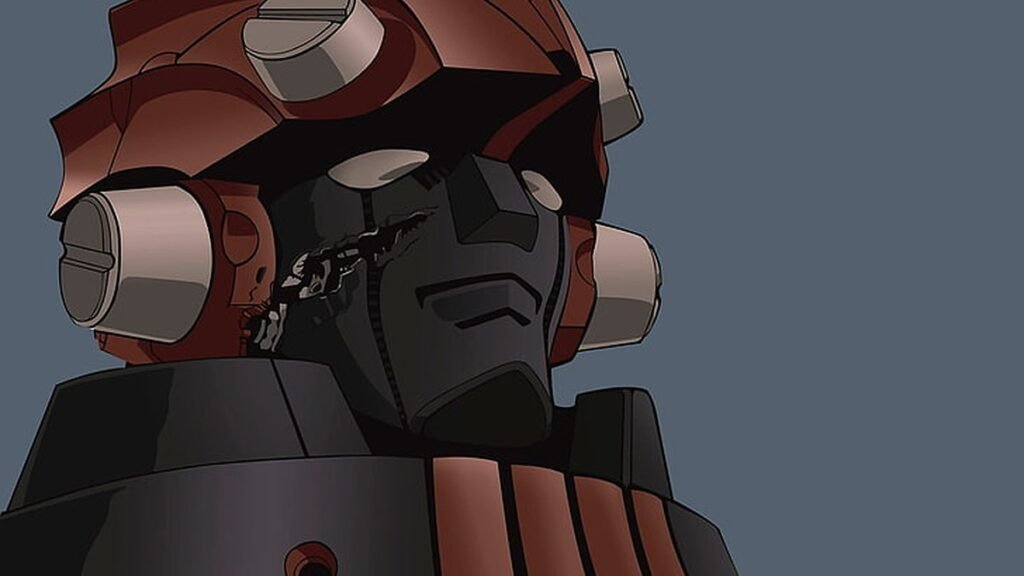
The Big O Was Cancelled in Japan After 13 Episodes. It Was So Popular in America That Cartoon Network Helped Fund the Other Half.
By Jimigrimm
Roger Smith lived in a city that had forgotten everything. Paradigm City lost its collective memory forty years before the show begins. Nobody knows what happened. Nobody knows why. And in the middle of this amnesia, a man in a double-breasted suit negotiates disputes between the powerful and the powerless, drives a black sedan with a phone in the back seat, and when negotiations fail, calls upon a giant robot with piston-powered fists that rise from beneath the city streets.
If that sounds like someone smashed Batman, a noir detective film, and a 1960s Japanese monster movie into a blender, that’s because that’s exactly what it was. And if you watched The Big O on Toonami, you experienced one of the rarest things in anime history: a show that exists in its complete form only because American viewers cared about it more than anyone in Japan did.
Sunrise Built It as a Love Letter to Everything They Grew Up On
The Big O was created by Keiichi Sato and directed by Kazuyoshi Katayama at Sunrise Studios. Before Big O, Sunrise had been a subcontractor on Warner Bros.’ Batman: The Animated Series, and the influence is impossible to miss. Roger Smith is a pastiche of Bruce Wayne: slicked-back hair, mansion, butler, no-gun policy, playboy persona hiding a vigilante mission. Cartoon Network later marketed the show as “One part Bond. One part Bruce Wayne. One part City Smashing Robot.”
But the show’s DNA runs deeper than Batman. Katayama grew up watching tokusatsu, the Japanese live-action special effects genre that produced Godzilla, Ultraman, and Giant Robo. He had previously worked on a low-budget tokusatsu homage called Red Baron and was frustrated by its limitations. Big O was the show he felt Red Baron could have been with a bigger budget. He designed the robots first, as if he were pitching them to toy companies, with gimmicks like Big O’s “Sudden Impact” piston arms that he felt would make cool toys. The city of Paradigm was built to be the kind of setting those robots could destroy dramatically, because in tokusatsu, the destruction is the point.
The head writer, Chiaki Konaka, deliberately made Paradigm City a city of amnesiacs so he wouldn’t have to develop origin lore for the robots. Why do giant robots exist under the city? Nobody remembers. That creative shortcut became the show’s central mystery and its greatest strength. The amnesia wasn’t a plot device. It was the premise. Every episode asked: what does it mean to live in a world where nobody knows why anything exists, including themselves?
13 Episodes and a Cliffhanger
The Big O premiered on WOWOW satellite television in Japan on October 13, 1999. It was originally planned as a 26-episode series. But viewership was low. The show was cut to 13 episodes. When the production staff found out the series was being shortened, they made a deliberate choice: they ended on a cliffhanger, hoping someone, somewhere, would pick up the remaining 13 episodes.
Nobody in Japan did.
America Did
The English dub premiered on Toonami on April 2, 2001. It aired simultaneously on the weekday afternoon block at 5:30 PM and on the Midnight Run at 12:30 AM. The show connected with American audiences immediately. The noir aesthetic, the Batman parallels, the giant robot fights that felt like kaiju movies, and the mystery of Paradigm City’s lost memories all resonated with a Toonami audience that was used to straightforward action and suddenly had something that asked them to think.
Get the history behind the stories.
One email a week. Read it before it hits the feeds.
The fan response was strong enough that Cartoon Network made a decision that had almost no precedent in the anime industry: they co-funded a second season. Cartoon Network, Sunrise, and Bandai Visual partnered to produce the remaining 13 episodes that Japan had cancelled. An American cable network paid for the completion of a Japanese anime because the American audience demanded it.
Jason DeMarco, who served as executive producer on the second season, worked directly with the Japanese production team. Cartoon Network made two requests: more action, and reveal the mystery behind Paradigm City’s amnesia. Katayama admitted that he had never actually intended to reveal the mystery. He wanted to make an anthology of adventures set in the universe, not solve the puzzle. But the American producers insisted, so Konaka developed the amnesia concept into the show’s central theme for season two.
The second season premiered in Japan on Sun Television in January 2003. The American premiere followed on Adult Swim in August 2003. Along with the 13 episodes of season two, Cartoon Network had an option for 26 additional episodes. DeMarco has said that middling ratings and DVD sales in both countries made further episodes impossible. The Big O ended at 26 episodes, exactly as originally planned, but only because an audience on the other side of the planet refused to let 13 be the final number.
The Show That Proved the Flow Could Reverse
Here’s why The Big O matters beyond its own story.
The standard model of anime distribution has always flowed in one direction: Japan creates, the West consumes. Shows succeed or fail in Japan first, and if they succeed, they get exported. The Big O broke that model. It failed in Japan. It succeeded in America. And the American success funded the show’s completion. The creative flow reversed. For 13 episodes, The Big O is a Japanese product. For the full 26, it’s an international co-production that exists because American fans proved demand that the Japanese market couldn’t.
This almost never happens. Trigun was more popular in America than Japan, but America didn’t fund new Trigun episodes. Cowboy Bebop found its largest audience in the West, but the show was already complete. The Big O is one of the only anime in history where the American audience’s response directly caused the production of new episodes that would not have existed otherwise.
That makes it a landmark in the relationship between Japanese creators and Western audiences, even though most anime fans have never heard of it. The show that asked “what happens when a city forgets everything?” became the show that proved the anime industry hadn’t fully understood its own global audience.
The Noir Nobody Talks About
There’s a moment in the first season where Roger Smith is having dinner with R. Dorothy Wayneright, the android who lives in his mansion. Dorothy plays the piano. She plays it constantly, mechanically, without emotion. Roger finds it annoying. He tells her to stop. She ignores him. This goes on for episodes. And then one day, the music changes. Something shifts in what she’s playing. It’s still mechanical. She’s still an android. But there’s something in the notes that wasn’t there before. And Roger, the man who negotiates impossible situations for a living, doesn’t know what to say.
The show never tells you Dorothy developed feelings. It never uses the word “emotion” or “consciousness.” It just plays you a piano piece that sounds different from the ones before and lets you decide what that means. If you were watching on Toonami at 5:30 in the afternoon, sandwiched between Dragon Ball Z and whatever came next, that moment asked you to engage with a question that most shows aimed at your age group wouldn’t touch: what does it mean to be alive, and who gets to decide?
That’s The Big O. A show about a city with no memories, a man who dresses like Batman, a robot with piston fists, and an android who might be learning how to feel. It was cancelled in a country that created it and saved by a country that understood what it was trying to do.
Did you watch The Big O on Toonami or Adult Swim? Were you there for the afternoon block or the Midnight Run? Did the noir detective angle pull you in, or was it the giant robot fights? And the question that defined the entire show: did you ever figure out what happened to Paradigm City’s memories, or did you accept that not knowing was the point? We want to hear how Big O found you.
MORE LIKE THIS
-
Trigun Was Bigger in America Than It Ever Was in Japan. The Man Who Created It Was Selling Apartments When He Drew the First Page.
8 MIN READ -
FLCL Is Six Episodes Long. The Director of Avatar: The Last Airbender Ordered His Staff to Watch All of Them.
5 MIN READ -
Why Is Anime So Long? The Real Reason One Piece Has 1,100 Episodes and Western Shows Have 8.
5 MIN READ
Co-founder and co-host. Veteran. Grew up on cartoons. The MCU brought all of it back and pulled him into the comics side he never picked up as a kid. Curious by default. Passionate without needing to prove anything. Good at holding a conversation.