Batman vs Spider-Man: Who Has the Better Rogues Gallery? Villains Ranked
Batman vs Spider-Man: Who has the better rogues gallery? We compare Joker, Green Goblin, Venom, Two-Face, and more across comics, film, and games.
By Jimigrimm | February 10th, 2026
Table of Contents
- What Makes a Great Rogues Gallery?
- Batman Villains vs Spider-Man Villains: Complete List
- How Gotham and Arkham Asylum Make Batman’s Villains Work
- New York and Consequences: Spider-Man’s World
- Comics, Animation, Film, and Games Comparison
- Standalone Impact: Who Works Without the Hero?
- Head-to-Head Villain Matchups
- The Verdict (That Isn’t a Verdict)
Batman vs Spider-Man: Who Has the Better Rogues Gallery?
This is the debate that never dies.
You’ve had it with your friends. You’ve seen it in YouTube comment sections. You’ve watched it derail entire group chats. And if you’re reading this, you probably already have a side.
Batman vs Spider-Man. Who has the better rogues gallery?
Not who would win in a fight. Not who’s the better hero. But who has the villains that matter more. The ones that stick with you. The ones that define what a great rogues gallery even means.
Here’s the thing: both heroes have iconic villains. Both have rogues galleries that shaped the entire superhero genre. And both have antagonists who work just as well outside their hero’s orbit as they do within it.
So how do you even compare them?
You start by breaking down what makes a rogues gallery great in the first place. Then you look at the villains themselves, the worlds they inhabit, and how they’ve been adapted across comics, animation, film, and games. You compare themes. You compare cultural impact. You compare staying power.
And then you let the people decide.
What Makes a Great Rogues Gallery?
Before we pit these two against each other, let’s set the criteria.
A great rogues gallery isn’t just a list of memorable bad guys. It’s a collection of antagonists who do a few specific things really well:
Variety of themes and powers. You need different types of villains. Street-level threats and cosmic horrors. Geniuses and brutes. Sympathetic and irredeemable.
Personal connection to the hero. The best villains aren’t just obstacles. They reflect the hero’s fears, failures, and moral boundaries. They test who the hero is.
Adaptability across media. A villain who only works in one medium is limited. The greats work in comics, animation, live action, and games without losing what makes them compelling.
Standalone appeal. Can the villain carry a story without the hero? Do they have their own mythos, their own fans, their own reason to exist beyond ‘Spider-Man’s enemy’ or ‘Batman’s nemesis’?
Cultural impact. Did they change the genre? Did they influence villains that came after them? Do non-comic readers know who they are?
Longevity. Have they stayed relevant across decades, or did they peak once and fade?
With those benchmarks in mind, let’s get into it.
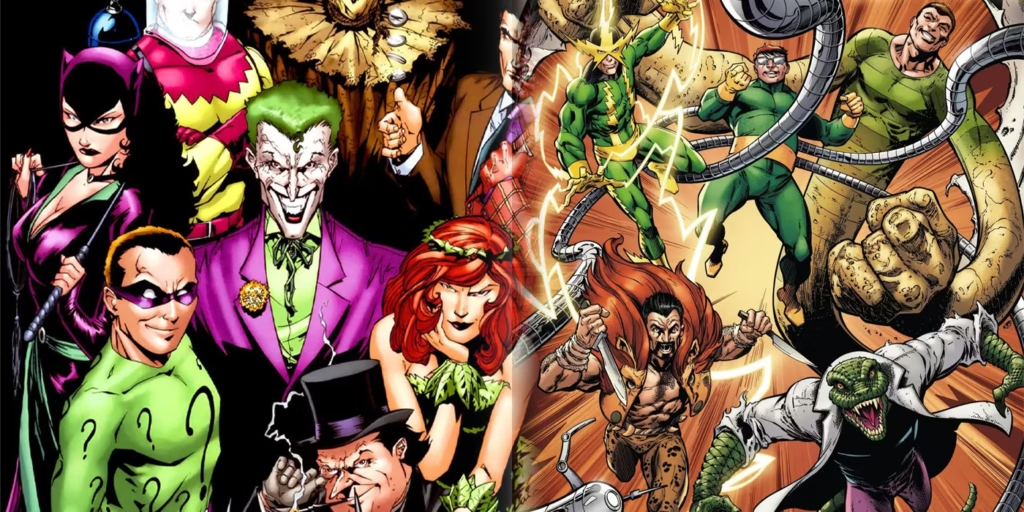
Batman Villains vs Spider-Man Villains: Complete Draft Board
Here’s the starting lineup for both sides. Eight villains each. First appearance, core concept, and key defining stories or adaptations.
SPIDER-MAN VILLAINS
1. Green Goblin (Norman Osborn)
First appearance: The Amazing Spider-Man #14 (July 1964)
Core concept: Industrialist driven insane by experimental formula becomes Spider-Man’s most personal and sadistic enemy.
Key stories/adaptations: ‘The Night Gwen Stacy Died’ (Amazing Spider-Man #121-122, 1973), Spider-Man (2002 film), Spider-Man: No Way Home (2021)
2. Doctor Octopus (Otto Octavius)
First appearance: The Amazing Spider-Man #3 (July 1963)
Core concept: Brilliant scientist fused to mechanical tentacles becomes both a physical and intellectual threat.
Key stories/adaptations: Superior Spider-Man (2013-2014), Spider-Man 2 (2004 film), Spider-Man: No Way Home (2021)
3. Venom (Eddie Brock)
First appearance: The Amazing Spider-Man #300 (May 1988)
Core concept: Alien symbiote rejected by Spider-Man bonds with a vengeful journalist to become a dark mirror of the hero.
Key stories/adaptations: Venom: Lethal Protector (1993), Spider-Man 3 (2007), Venom (2018), solo film franchise
4. Sandman (Flint Marko)
First appearance: The Amazing Spider-Man #4 (September 1963)
Core concept: Career criminal transformed into living sand becomes one of the most tragic villains in Spider-Man’s rogues gallery.
Key stories/adaptations: Spider-Man 3 (2007), Spider-Man: No Way Home (2021)
5. Electro (Max Dillon)
First appearance: The Amazing Spider-Man #9 (February 1964)
Core concept: Electrical engineer gains power over electricity and becomes a living battery of destruction.
Key stories/adaptations: The Amazing Spider-Man 2 (2014), Spider-Man: No Way Home (2021)
6. Mysterio (Quentin Beck)
First appearance: The Amazing Spider-Man #13 (June 1964)
Core concept: Hollywood special effects artist uses illusions and mind games to torment Spider-Man.
Key stories/adaptations: ‘Guardian Devil’ (Daredevil, 1998), Spider-Man: Far From Home (2019)
7. Kraven the Hunter (Sergei Kravinoff)
First appearance: The Amazing Spider-Man #15 (August 1964)
Core concept: Big game hunter obsessed with proving himself the world’s greatest predator by hunting Spider-Man.
Key stories/adaptations: ‘Kraven’s Last Hunt’ (1987), Kraven the Hunter (2024 film)
8. Carnage (Cletus Kasady)
First appearance: The Amazing Spider-Man #344 (March 1991)
Core concept: Serial killer bonds with offspring of Venom symbiote to become pure chaos and violence incarnate.
Key stories/adaptations: Maximum Carnage (1993), Venom: Let There Be Carnage (2021)
BATMAN VILLAINS
1. Joker
First appearance: Batman #1 (Spring 1940)
Core concept: Homicidal clown and agent of chaos who exists as Batman’s philosophical opposite and greatest tormentor.
Key stories/adaptations: The Killing Joke (1988), The Dark Knight (2008), Batman: The Animated Series (1992-1995), Joker (2019)
2. Two-Face (Harvey Dent)
First appearance: Detective Comics #66 (August 1942)
Core concept: Gotham’s noble district attorney scarred and broken into a split personality driven by chance and duality.
Key stories/adaptations: The Long Halloween (1996-1997), The Dark Knight (2008), Batman: The Animated Series
3. Catwoman (Selina Kyle)
First appearance: Batman #1 (Spring 1940)
Core concept: Master thief who walks the line between villain and anti-hero, romantically entangled with Batman.
Key stories/adaptations: Batman Returns (1992), The Dark Knight Rises (2012), The Batman (2022)
4. Riddler (Edward Nygma)
First appearance: Detective Comics #140 (October 1948)
Core concept: Criminal mastermind obsessed with proving his intellectual superiority through elaborate riddles and puzzles.
Key stories/adaptations: Batman Forever (1995), Batman: The Animated Series, The Batman (2022)
5. Penguin (Oswald Cobblepot)
First appearance: Detective Comics #58 (December 1941)
Core concept: Deformed crime lord who uses his wealth and umbrella-themed gadgets to control Gotham’s underworld.
Key stories/adaptations: Batman Returns (1992), Gotham (2014-2019), The Batman (2022)
6. Scarecrow (Jonathan Crane)
First appearance: World’s Finest Comics #3 (September 1941)
Core concept: Psychologist who weaponizes fear through hallucinogenic toxins that exploit victims’ deepest phobias.
Key stories/adaptations: Batman Begins (2005), Batman: Arkham Asylum (2009), Batman: The Animated Series
7. Poison Ivy (Pamela Isley)
First appearance: Batman #181 (June 1966)
Core concept: Eco-terrorist with control over plant life and pheromone-based mind control abilities.
Key stories/adaptations: Batman & Robin (1997), Batman: The Animated Series, Harley Quinn (2019-present)
8. Bane
First appearance: Batman: Vengeance of Bane #1 (January 1993)
Core concept: Brilliant tactician enhanced by the super-steroid Venom, famous for breaking Batman’s back.
Key stories/adaptations: Knightfall (1993-1994), The Dark Knight Rises (2012), Batman: Arkham Origins (2013)
How Gotham City and Arkham Asylum Make Batman’s Villains Work
Batman’s rogues gallery doesn’t just benefit from great villains. It benefits from Gotham City and Arkham Asylum.
Gotham isn’t just a setting. It’s a character. It’s a city so corrupt, so broken, so soaked in crime and despair that it feels like it creates Batman’s villains. The city’s rot is the breeding ground for their madness.
The Joker couldn’t exist in Metropolis. Two-Face wouldn’t work in Central City. These villains are products of Gotham’s specific brand of decay. A place where the justice system is bought, where hope is a luxury, and where the only response to systemic failure is either becoming Batman or becoming his enemy.
And then there’s Arkham Asylum.
Arkham is more than a prison. It’s a revolving door. It’s a gothic horror institution where the inmates run the asylum as much as the guards do. It’s the place where Batman’s villains don’t just get locked up. They get refined. They get worse.
The concept of Arkham has shaped how Batman’s rogues gallery works across every medium. In comics, it’s where arcs like Arkham Asylum: A Serious House on Serious Earth (1989) turned the asylum into a psychological nightmare. In animation, Batman: The Animated Series made it a recurring stage for tragedy and terror. In games, the Batman: Arkham series (2009-2015) built entire worlds around it, making Arkham the ultimate testing ground for Batman and his enemies.
Arkham reinforces the idea that Batman’s villains aren’t just criminals. They’re patients. They’re broken people trapped in cycles of obsession and madness. And that gives them a tragic dimension that most superhero rogues galleries don’t have.
Gotham and Arkham don’t just support Batman’s villains. They justify them. They make them inevitable.
New York and Consequences: Why Spider-Man’s Villains Hit Different
Spider-Man’s villains don’t have Gotham. They don’t have Arkham. What they have is New York City and the weight of consequences.
New York in Spider-Man’s world isn’t a gothic nightmare. It’s real. It’s grounded. It’s the place where people live, work, and try to survive. And when Spider-Man’s villains attack, real people get hurt.
That’s the difference. Batman’s villains operate in a heightened reality where Gotham is already broken. Spider-Man’s villains break things that were working. They disrupt normalcy. They turn everyday spaces into battlegrounds.
But more than that, Spider-Man’s villains are tragic in a way Batman’s often aren’t.
Norman Osborn is a brilliant businessman destroyed by his own ambition and mental illness. Otto Octavius is a scientist whose accident turned him into a monster he never wanted to be. Flint Marko just wanted money to save his daughter. Curt Connors was trying to cure his disability and became the Lizard instead.
These aren’t people who chose evil because Gotham broke them. These are people who made mistakes, had accidents, or were pushed into villainy by circumstance. And Peter Parker feels responsible for a lot of it.
That’s the other piece: consequences matter more in Spider-Man’s world. When Gwen Stacy dies, it’s because Peter failed to save her. When Uncle Ben dies, it’s because Peter didn’t stop the burglar. When villains escape, Peter blames himself.
Batman carries guilt, but Spider-Man drowns in it. And his villains are extensions of that guilt. They’re reminders of every time he wasn’t fast enough, smart enough, or strong enough.
New York grounds Spider-Man’s villains in reality. Consequences make them hurt. And that’s why they hit different.
Comics, Animation, Film, and Games: Who Adapts Better?
Great villains work across media. Let’s see how Batman and Spider-Man’s rogues galleries hold up in comics, animation, live-action film, and video games.
Comics
Winner: Tie. Both have iconic runs. Batman has The Killing Joke, The Long Halloween, and Knightfall. Spider-Man has Kraven’s Last Hunt, Maximum Carnage, and Superior Spider-Man. Quality is matched.
Animation
Winner: Batman. Batman: The Animated Series (1992-1995) is the gold standard for superhero animation and perfected nearly every Batman villain. It created Harley Quinn and redefined Mr. Freeze. Spider-Man’s animated shows are good but don’t reach the same heights.
Live-Action Film
Winner: Batman, narrowly. Heath Ledger’s Joker in The Dark Knight is an all-timer. But Spider-Man has Alfred Molina’s Doc Ock, Willem Dafoe’s Green Goblin, and the emotional weight of No Way Home bringing back multiple villains. Both are elite.
Video Games
Winner: Batman. The Arkham series (Asylum, City, Knight) gave definitive versions of Joker, Scarecrow, Riddler, and more. Spider-Man’s PS4/PS5 games are excellent but haven’t had the same multi-game impact on villain portrayals.
Standalone Impact: Which Villains Work Without the Hero?
The ultimate test: Can the villain carry a story without Batman or Spider-Man?
Joker has had multiple solo films (Joker 2019, The Dark Knight indirectly). Harley Quinn has solo comics, animated series, and films. Catwoman has carried solo series for decades.
Venom has sustained solo comics since 1993 and a film franchise that grossed over $1.3 billion without Spider-Man. That’s unprecedented.
Winner: Batman for breadth (Joker, Harley, Catwoman all work solo). Spider-Man for Venom’s complete independence.
Head-to-Head Villain Matchups
Let’s compare thematic equivalents:
- Joker vs Green Goblin: Chaos vs personal cruelty. Both iconic, Joker has broader cultural impact.
- Two-Face vs Sandman: Tragedy and duality. Two-Face is more complex, Sandman is more sympathetic.
- Catwoman vs Black Cat: Femme fatale thieves. Catwoman has more depth and cultural staying power.
- Riddler vs Mysterio: Intellectual challenges. Riddler has more adaptations, Mysterio had a perfect MCU arc.
- Bane vs Doctor Octopus: Physical and mental threats. Bane broke Batman, Ock became Spider-Man.
The Verdict (That Isn’t Really a Verdict)
So who wins?
If you value standalone cultural impact, breadth of iconic villains, and adaptability across every medium, Batman takes it. Joker alone is a global icon. Add Harley Quinn, Two-Face, Catwoman, and the rest, and you have the most recognizable rogues gallery in all of comics.
If you value emotional depth, tragic storytelling, and villains who feel human, Spider-Man takes it. His rogues gallery is built on people who made mistakes, not monsters who chose evil. That hits different.
The truth? Both are the best. And that’s not a cop-out. It’s recognition that these two heroes have rogues galleries so good, they define what great comic book villains even are.
Batman has the icons. Spider-Man has the tragedy. And fans of both should be grateful we get to argue about it.