Marvel and DC Stopped Making Comics Together for Over 20 Years. The Story of Why They Stopped and What Brought Them Back Is Bigger Than the Crossovers Themselves.
By Jimigrimm
Superman and Spider-Man are sharing a comic book again in 2026. If that sentence doesn’t hit you, you might not understand how impossible this was for the last two decades.
Marvel and DC, the two companies that built the entire superhero genre, refused to work together for over 20 years. No crossovers. No shared stories. No acknowledgment that the other universe even existed. The last time their characters officially met on the page was JLA/Avengers in 2003. After that, silence. Two decades of fans asking “why can’t we see Batman meet Spider-Man again?” and both companies pretending the question didn’t exist.
Now, in 2026, the crossovers are back. Deadpool met Batman in 2025. Superman and Spider-Man are reuniting for the 50th anniversary of their first meeting. And the story of how all of this happened, why it stopped, and what it means that it’s happening again, is one of the most fascinating behind-the-scenes sagas in comics history.
It Started With a Handshake Over The Wizard of Oz
The first time Marvel and DC actually cooperated on anything was 1975, and it wasn’t even a superhero story. Both companies held competing licenses to The Wizard of Oz (DC had the movie rights, Marvel had the original book) and instead of publishing rival versions, they agreed to produce one comic together. That small act of cooperation opened a door that nobody expected.
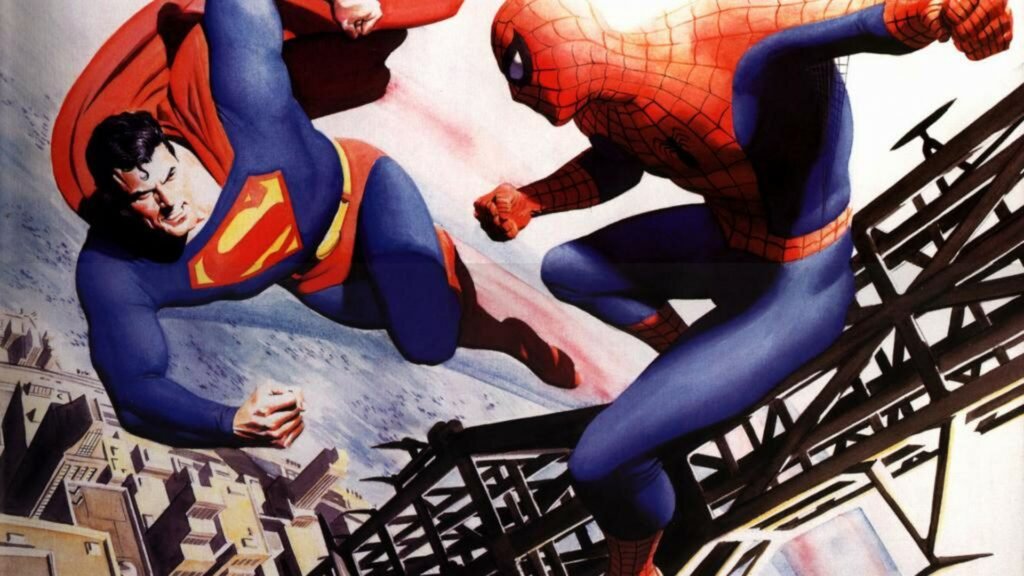
A year later, in 1976, Superman vs. The Amazing Spider-Man: The Battle of the Century hit shelves. Written by Gerry Conway with art by Ross Andru (and uncredited assists from legends Neal Adams and John Romita Sr.), it was the first time characters from Marvel and DC had ever officially appeared in the same story. The oversized Treasury Edition format made it feel like an event. The cover alone was a statement: the two biggest names in comics were finally in the same room.
The story itself followed crossover tradition. Superman and Spider-Man fought each other briefly (misunderstanding, naturally), then teamed up to take down Lex Luthor and Doctor Octopus. But the story wasn’t really the point. The point was that it existed at all. Two rival companies, competing for the same readers, the same shelf space, and the same cultural relevance, agreed to put their egos aside and give fans something they’d been imagining since childhood.
It worked. It sold. And it opened the floodgates.
The Golden Age of Marvel/DC Crossovers
After that first Superman/Spider-Man team-up, the crossovers kept coming. A 1981 sequel paired Superman and Spider-Man again, this time against Parasite and Doctor Doom, with Jim Shooter, Marv Wolfman, and John Buscema behind it. Batman fought the Hulk. The Uncanny X-Men met the New Teen Titans in a 1982 crossover by Chris Claremont and Walt Simonson that brought together the two best-selling team books in comics.
Then in 1983, a planned JLA/Avengers crossover fell apart due to a dispute between the two companies. The details have been debated for decades, but the result was clear: Marvel and DC stopped working together for the rest of the 1980s. The door that opened in 1976 slammed shut.
It took until the early 1990s for the crossovers to resume, starting with a pair of Batman/Punisher one-shots. From there, the ’90s became the most crossover-heavy decade in Marvel/DC history. Darkseid met Galactus. Silver Surfer met Superman. Batman teamed up with Captain America in a World War II story by John Byrne. Batman and Spider-Man faced Kingpin and Ra’s al Ghul together. Superman discovered that Galactus was the real cause of Krypton’s destruction. It was a golden era for fans who grew up wondering what would happen if these characters ever met.
The peak came in 1996 with DC vs. Marvel (or Marvel vs. DC, depending on which company published the issue). For the first time, the ENTIRE universes collided. Fans actually voted on some of the match outcomes. Superman beat Hulk. Spider-Man beat Superboy. Batman beat Captain America. Wolverine beat Lobo. Storm beat Wonder Woman. The results were controversial, the stories were wild, and the aftermath created something nobody saw coming: the Amalgam Universe.
Amalgam mashed Marvel and DC characters together into brand new heroes. Super Soldier (Captain America fused with Superman). Dark Claw (Batman fused with Wolverine). Spider-Boy (Spider-Man fused with Superboy). Amazon (Wonder Woman fused with Storm). For a brief moment, two rival companies created an entirely new shared universe just to see what would happen. It was insane. It was fun. And it proved that when Marvel and DC actually work together, the results are unlike anything either company can produce alone.
Then It All Stopped. For Twenty Years.
In 2003, Kurt Busiek and George Perez finally delivered the JLA/Avengers crossover that had been planned and abandoned twenty years earlier. It was a massive four-issue miniseries, critically acclaimed, and felt like the culmination of everything the crossover era had built toward.
And then nothing.
No official crossover was published between Marvel and DC from 2004 to 2025. Twenty-one years. An entire generation of comic readers grew up never seeing Batman and Spider-Man in the same panel. Never seeing Superman and the X-Men acknowledge each other’s existence. The Amalgam Universe became a footnote that older fans referenced and younger fans thought was a joke.
The reasons were never publicly spelled out in one clean explanation. Corporate rivalry played a role. Both companies had different creative philosophies that became harder to align as their publishing lines grew more complex. Legal teams on both sides made collaboration difficult. And as the MCU and DC’s film universe became the dominant way most people experienced these characters, the incentive to share them on the page shrank. Why help your competitor’s brand when you’re both fighting for box office dominance?
Whatever the reasons, the result was a two-decade gap that fans felt every year.
2025 Broke the Seal. 2026 Blew the Door Open.
In 2025, Marvel published Deadpool/Batman #1 and DC published Batman/Deadpool #1. The first intercompany crossover in over 20 years. Both books were packed with backup stories featuring additional character pairings from both universes. Fans and critics praised them. Sales were massive.
The success proved what fans had been saying for two decades: the appetite for these crossovers never went away. The companies just weren’t feeding it.
That success led directly to 2026, which is shaping up to be the biggest year for Marvel/DC crossovers since the Amalgam era. DC published Superman/Spider-Man #1 on March 25, written by Mark Waid with art by Jorge Jimenez. The main story pits Clark Kent and Peter Parker against Brainiac and Doctor Octopus after both reporters stumble onto the same conspiracy. But the backup stories are where it gets truly stacked. Tom King and Jim Lee tell a Lois Lane and Mary Jane Watson story. Matt Fraction and Steve Lieber put Jimmy Olsen with Carnage. Gail Simone and Belen Ortega pair Power Girl with the Punisher. Sean Murphy sends Superboy to meet Spider-Man 2099.
Marvel’s answer, Spider-Man/Superman #1, hits in April. Brad Meltzer and Pepe Larraz handle the main story with Spider-Man and Superman facing Lex Luthor and Norman Osborn. Dan Slott and Marcos Martin put Spider-Man Noir with the original Golden Age Superman. Geoff Johns and Gary Frank, Jason Aaron and Todd Nauck, Brian Michael Bendis and Sara Pichelli, Jeph Loeb and Jim Cheung, Stephanie Phillips and Phil Noto pairing Spider-Gwen with Supergirl. The creative talent assembled across both books is genuinely historic.
And here’s what fans are already speculating about: 2026 is the 30th anniversary of the Amalgam Universe. The X-Men and Teen Titans, two teams with their own iconic 1982 crossover, have been conspicuously absent from both the Deadpool/Batman and Superman/Spider-Man books. Fans are connecting dots. Whether those dots actually lead somewhere or not, the conversation alone proves how badly the community wants this to keep going.
Why This Matters Beyond the Comics
The Marvel/DC crossover story is really a story about what happens when corporate rivalry gets in the way of what fans actually want. For 20 years, two companies that exist because of the same audience refused to collaborate because of business. Not because of creative differences. Not because the stories wouldn’t work. Because boardrooms and legal teams said no.
The fact that it took a Deadpool comic to break the ice is both hilarious and telling. Deadpool is the character who breaks rules for a living. Of course he’s the one who walked through the wall that both companies spent two decades building.
But beyond the humor, what these crossovers represent is something fans have always understood that corporations are slow to learn: the characters belong to the culture, not just the company that publishes them. Superman and Spider-Man meeting isn’t a licensing deal. It’s a cultural event. It’s two halves of the same mythology finally acknowledging each other. And the fact that it’s happening again, 50 years after it first happened, with creative teams that include some of the best writers and artists working in comics today, feels like more than a marketing play. It feels like comics remembering what they’re supposed to be.
What’s the Marvel/DC crossover you’ve always wanted to see? X-Men vs. Teen Titans? Avengers vs. Justice League again? A new Amalgam Universe? Or is there a matchup nobody’s thought of that would break the internet? Drop it in the comments.
READ NEXT