
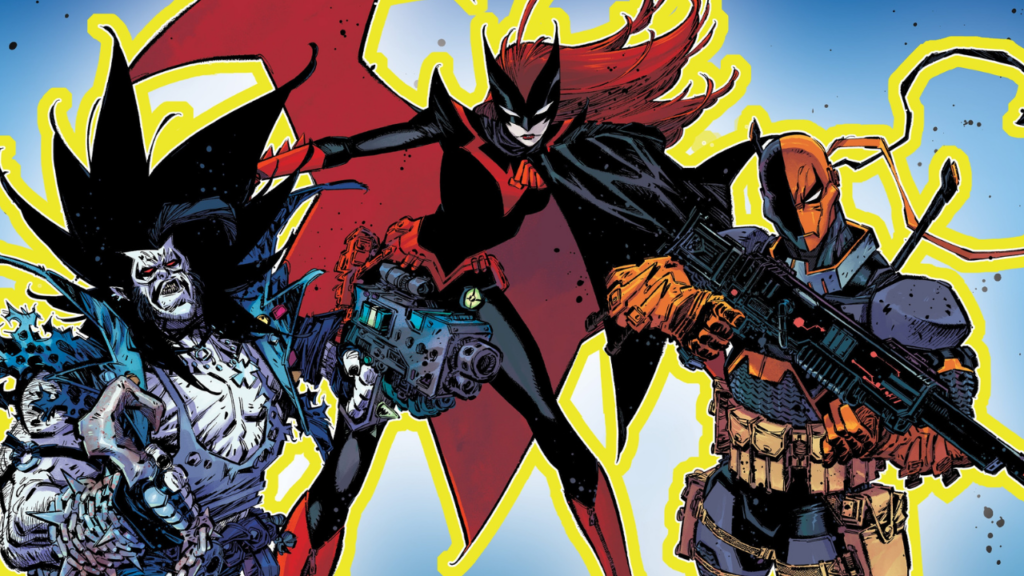
Where Do I Start? Marvel and DC Have Been Trying to Answer That Since 2000
By Jimigrimm
DC has three new series arriving September 2, 2026 under a banner called Next Level, and DC describes them as “fresh entry points for readers” across its universe. More creator-driven first issues are coming behind them.
Marvel’s publishing president said the same problem out loud in 2000. In an Associated Press report that October, Bill Jemas explained why Marvel was launching the Ultimate line: longtime readers loved the continuity and the complexity, and those same qualities had made Marvel hard for a new generation to walk into. Ultimate Spider-Man was pointed at readers nine to twelve.
Jemas had laid out the business case that June in the Washington Post. The industry had spent roughly a decade talking about bringing new fans in while readership kept falling. Ultimate was the answer to that, a separate line where Marvel’s biggest characters started over for people who were not carrying decades of back issues. What it converted is a blank. Marvel never published how many Ultimate readers had never bought a comic before, and that same gap follows every relaunch that comes after it.
A quarter century sits between those two announcements. The sentence barely changed.
I came to comics the way a lot of people my age did. I grew up on the cartoons and knew the characters long before I was buying books, and I started reading heavily once the MCU became a thing. So the question these publishers keep answering is the same one I once had to answer for myself.
What the publishers actually did
DC put out 52 new first issues in 2011 and told retailers the point was a line that both new and existing readers could pick up. The launch worked commercially. DC reported more than five million comics sold in the first six weeks. Justice League #1 cleared 250,000 copies by DC’s count, Batman #1 and Action Comics #1 reportedly cleared 200,000, and all 52 first issues sold out and went back to press.
The retailers Publishers Weekly talked to the following year described the people walking in. Aaron Holland said the new first issues were easier to sell to new customers, including college students who had written DC off as impenetrable. Mission Comics owner Leef Smith noticed younger readers coming in. Atomic Books co-owner Ben Ray said the relaunch brought in new readers and that a good number of them stuck around, even as what they bought shifted over time. A retailer at House of Secrets saw more lapsed readers than brand new ones and worried out loud that rewriting continuity would cost DC with the people already there.
Then DC commissioned Nielsen to survey the people actually buying the books, sampling in-store customers, online respondents and digital customers. More than 70 percent called themselves avid fans. More than a quarter of in-store buyers were lapsed readers coming back. About 5 percent said they were reading comics for the first time.
That 5 percent number gets thrown around as proof the whole thing failed to bring in anybody, and DC’s own executive said not to use it that way. John Rood cautioned that the survey almost certainly overrepresented passionate fans, since passionate fans are the people most likely to fill out a survey about comics. He also noted the 4 to 5 percent first-timer figure showed up consistently across all three samples.
Marvel went a different direction in 2012. Marvel NOW relaunched a pile of titles with new first issues and deliberately did not erase the continuity underneath them. Joe Quesada said at the time that Marvel wanted new readers without telling the existing hardcore audience that everything they had already bought no longer counted.
The direct market numbers show the size of the opening order spike and not much else. Publishers Weekly’s April 2013 analysis put the average Marvel NOW #1 around 119,000 and the average #2 around 64,000, a 46 percent drop between the first and second issue. Of the 16 titles that had shipped at least five issues by then, only Superior Spider-Man and Avengers Arena held more than half their opening level. Those numbers are retailer orders, not readers. Marvel hung multiple variant covers on those first issues that retailers only got by hitting minimum-order formulas, plus discounts for ordering deeper, a setup Publishers Weekly called a “powerful sales tool.” It pushed opening orders up. How much of any given first issue’s total came from the incentives instead of demand is not something anybody can separate out from the outside. A year later, 19 of the original 28 Marvel NOW titles had been relaunched with another #1, cancelled, or both.
The relaunch that went the other way
DC pitched Rebirth in 2016 as bringing back the best of what came before while keeping current stories intact, and Geoff Johns talked about restoring things he felt had gone missing, legacy and love and hope among them. DC later described it as putting substantial character history back and moving toward tighter continuity again.
Get the history behind the stories.
One email a week. Read it before it hits the feeds.
DC’s own year-end look back at 2016 went past the continuity mechanics. DC said Rebirth was not a reboot, that it brought back generations of readers who had felt “shut out by The New 52” and wanted their years with these characters to count again, and that it did that while holding onto the newer fans the New 52 had brought in.
Both moves moved product. DC had multiple Rebirth first issues going back for second printings within weeks. What nobody has published is a number on either end of it, how many first-time readers Rebirth brought in or how many of the New 52 newcomers were still there afterward, and DC’s account of keeping them is DC grading DC. The two launches together complicate the idea that history is simply in the way.
What's confirmed and what isn't
All of that is on the record, and so is the fact that it never stopped. Dawn of DC arrived in 2023, DC All In and the Absolute Universe in 2024, Next Level in 2026, and Marvel sold its new Ultimate line as a place to get in “at the ground level.”
Just as much is not established. Nothing in the record shows these initiatives failed. Absolute Batman #1 sold out at the distributor before it shipped, went back for a second printing, and DC called it the bestselling comic of 2024, though how many of those buyers were new to comics has never been established. Neither has the idea that publishers renumber primarily because first issues sell, which is a reasonable suspicion with no executive on record confirming it. And nobody has published how many first-time readers from any of these launches were still buying a year later, the one thing that would tell you whether the newcomers stayed.
Direct market estimates count copies ordered by retailers and a publisher’s own announced total counts copies sold, so five million comics is not five million readers.
Digital changed the problem
The old version of this was partly a supply problem. Retailers told Publishers Weekly in 2012 that Marvel had real trouble keeping parts of its collected backlist in print, so a reader could know exactly what they wanted and still not be able to buy it. Marvel Unlimited and DC Universe Infinite put decades of the catalog behind one monthly fee. How much of the old availability problem that erased has never been measured, and the archive itself is still incomplete.
A Marvel Unlimited catalog audit in May 2026 listed a long stretch of missing Spider-Man issues across Spectacular Spider-Man, Web of Spider-Man, Spider-Man and Marvel Team-Up. Marvel added dozens of previously absent classic Spider-Man issues that same month, which tells you the archive is still being filled in rather than finished.
The reader threads describe a different kind of stuck. In August 2026, a reader said downloading Marvel Unlimited made it worse. Multiple Spider-Man series running at once, numbering that restarts, different volumes with the same name, events with hundreds of tie-ins. They said they didn’t expect to read all of it. What they wanted was a reasonably chronological place to start in modern Marvel, and they couldn’t find one.
Secret Wars was the goal for another user that same month, who could not work out where it begins, what counts as canon, or which background was actually required. A reader in July went looking for a reading order and found that different search results gave different answers. Somebody who came in through the games and the movies said in June that the sheer number of runs made it impossible to tell where anything started.
The advice that comes back in those threads is usually a version of the same thing. Pick a character you like. Pick a run. Don’t try to read everything. That advice is correct, and it asks the newcomer to throw out the assumption that produced the question. Somebody who does not yet understand how superhero publishing is organized has no way to tell which “anywhere” is a good anywhere.
Part of the barrier looks like it lives in the reader rather than the books. In a 2024 thread, one person said they held off getting into comics until their thirties because they thought they needed the full history first, then found out they never did.
Why it keeps coming back
Marvel and DC are not bad at this. They have run versions of this play with real money behind it for a quarter century, several of them landed as major commercial launches, and they keep coming back to it.
The trouble is that an ongoing universe never stops adding to itself. Every entry point built in 2011 has fifteen more years of story stacked on top of it now. Plenty of clean first issues end up as one of several #1s carrying the same name, which is what those threads keep circling back to. The fix has a shelf life. Nobody has measured how long, and the only evidence is the pattern: 2000, 2011, 2012, 2016, 2023, 2024, 2026.
Underneath that sits the tension Quesada named in 2012 and DC described living through in 2016. The history is part of what the people already reading are invested in, and that same stack looks like a list of prerequisites to somebody coming in cold. That leaves a publisher trying to simplify the way in without making the history feel disposable, so it builds another door instead.
Whether any publisher thinks of it that way, as maintenance rather than a fix, is not something anybody has on the record. It would explain the pattern. That’s not the same as proving it.
I got in because the movies handed me a door I already knew how to open. Plenty of people are standing where I was standing, waiting on somebody to just tell them where to start.
So tell me yours. What was the first comic that actually stuck, and would you hand that same book to somebody just getting in?
MORE LIKE THIS
-
Marvel and DC Stopped Making Comics Together for Over 20 Years. The Story of Why They Stopped and What Brought Them Back Is Bigger Than the Crossovers Themselves.
6 MIN READ -

The Voices Behind Your Childhood Are Real People. Most Fans Have No Idea How Much They Shaped the Characters You Love.
6 MIN READ -
These Superhero Shows Were Cancelled for Reasons That Had Nothing to Do With Quality. Fans Never Got Over It.
6 MIN READ
Co-founder and co-host. Veteran. Grew up on cartoons. The MCU brought all of it back and pulled him into the comics side he never picked up as a kid. Curious by default. Passionate without needing to prove anything. Good at holding a conversation.