
How Marvel Got From Endgame to Doomsday: The Deals, the Disasters, and the Seven Years Nobody Planned
By Jimigrimm
Avengers: Endgame came out April 26, 2019. Avengers: Doomsday comes out December 18, 2026. Seven years and nearly eight months between Avengers movies. The longest gap before that was three years. If this stretch of the MCU felt scattered to you, unplanned, like the buildup that carried us to Endgame was just gone, you weren’t imagining it. I felt it too. I never had one moment where the MCU lost me. What I felt was the absence of a spine. And when I started pulling the actual record on why, the answer wasn’t one thing. It was a pile of things, deals and a pandemic and a firing and two strikes, all landing on the same seven years. Every one of them has receipts. So this is the whole story of how we got from Endgame to Doomsday.
The Deal That Closed Five Weeks Before Endgame
Start with the piece I believe bent the entire saga: the Fox deal. My memory had it pegged to 2017, and I was half right. Disney announced the acquisition of Fox’s film and TV business in December 2017, and the deal actually closed on March 20, 2019, after a bidding war with Comcast drove the price from $52.4 billion to $71.3 billion. Do the math on that closing date. Marvel got the X-Men, the Fantastic Four, and Deadpool back five weeks before Endgame premiered. The deal was announced while Phase 4 was still being written, and by the time Marvel publicly unveiled the post-Endgame slate at Comic-Con in July 2019, the merger was done.
And Disney said the quiet part in its own press release. The official announcement pitched the deal as the chance to bring the X-Men, the Fantastic Four, and Deadpool back into the Marvel family and build, in Disney’s own words, “more complex worlds of inter-related characters and stories that audiences have shown they love.” That’s the corporation telling you the plan in 2017: get everybody into one universe. My opinion: this is why the saga became a multiverse saga at all. The multiverse is the merger mechanism. It’s how you take twenty years of Fox X-Men movies, a rebooted Fantastic Four, and the existing MCU and legally, narratively, get them in one room. Look at what Doomsday actually is, McKellen and Stewart and Marsden standing next to Downey and Evans, and tell me the movie isn’t the deal finally paying out on screen.
The Mandate That Flooded the Zone
The second force wasn’t creative either. Disney+ launched in November 2019, and a year later, under new CEO Bob Chapek, the company went all in on streaming growth. Marvel, a studio that had never really been in the TV business, suddenly had to feed a platform. WandaVision, The Falcon and the Winter Soldier, Loki, What If, Hawkeye, Moon Knight, Ms. Marvel, She-Hulk, Secret Invasion, and more, stacked on top of an increased movie output.
I’ll say my piece on this straight. As a fan and as a creator who covers this stuff, I enjoyed it. More Marvel to watch, more to talk about, more to research. WandaVision, The Falcon and the Winter Soldier, and Loki started strong, and there were real pieces of quality in that run. But I could also see exactly why a casual viewer felt lost, confused, and overwhelmed. The shows stopped being bonus content and started being required reading. Fans called it homework, and they weren’t wrong. When Captain America: Brave New World finally came out, keeping up meant six hours of a four-year-old Disney+ show first. That’s a tax on casual viewers, and casual viewers are the ones who make a movie a billion-dollar movie.
Then the man who runs Disney conceded it. In July 2023, Bob Iger told CNBC that Marvel’s push into TV “diluted focus and attention,” and that in the zeal to grow streaming content, Disney taxed its own people way beyond their limits. He later went further, saying flat out that “quantity does not necessarily beget quality,” blamed his predecessor’s spending, and cut Marvel’s output to two or three movies and about two shows a year. When the CEO’s own postmortem matches what fans were saying in comment sections in 2023, that’s not a hot take anymore. That’s the record.
The Two Years the World Took
Then the pandemic hit, and the machine that had released at least one movie every year since 2008 released nothing in 2020. Zero. The momentum Marvel spent a decade building, where every movie fed the next one and the audience never got a chance to cool off, stopped cold for the first time.
Black Widow tells the whole COVID story in one movie. Scheduled for May 2020, delayed three times, and finally released in July 2021 simultaneously in theaters and on Disney+ for a $30 Premier Access fee. It opened to a pandemic-best $80 million domestic and then collapsed, and theater owners publicly blamed the streaming release. Then Scarlett Johansson, the woman who’d been in this franchise since 2010, sued Disney for breach of contract, saying her pay was tied to a theatrical run the company gave away to pump its streaming service. Disney’s public response called her lawsuit callous, in the middle of a pandemic, aimed at one of the faces of its biggest franchise. They settled two months later, but the damage was visible from space. The era where Marvel, its stars, and its audience all pulled in the same direction ended in a courtroom filing.
Get the history behind the stories.
One email a week. Read it before it hits the feeds.
The Villain Who Fell Out of the Plan
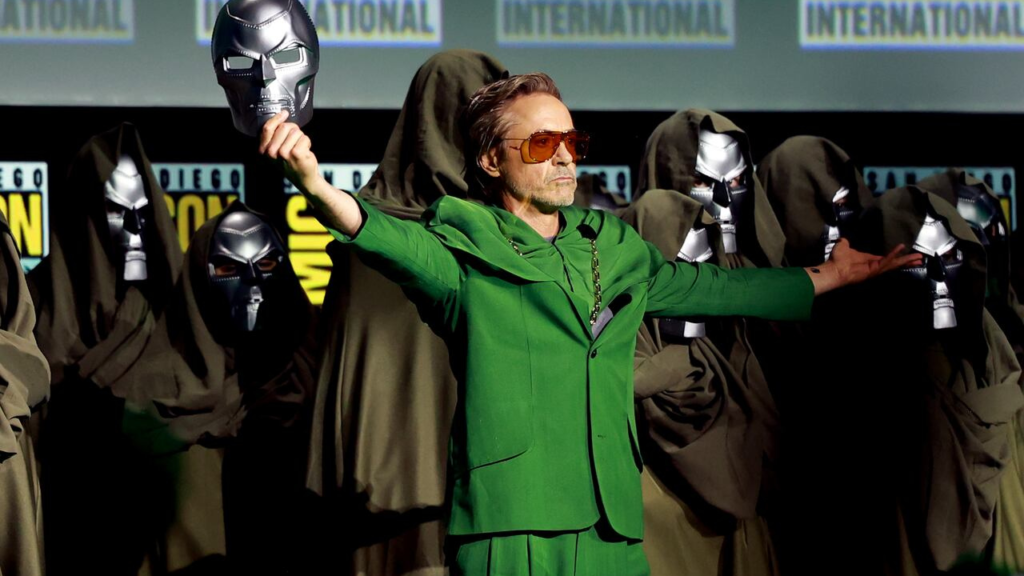
Now the one everybody knows, and the one where the truth turned out messier than the timeline we all watched. The Multiverse Saga was built around Kang. Jonathan Majors showed up in the Loki finale, headlined Ant-Man and the Wasp: Quantumania, and the next Avengers movie was literally titled The Kang Dynasty. Then the problems landed back to back. Quantumania opened in February 2023 and became one of the phase’s biggest disappointments, failing to reach $500 million worldwide. A month later, Majors was arrested for assault. In December 2023 he was convicted, and Marvel cut ties the same day. In July 2024, Downey put on the mask at Comic-Con and The Kang Dynasty became Doomsday.
That’s the public version. The inside version came out later, from Feige himself. In a 2025 Variety interview, he admitted the studio had already concluded Kang “wasn’t big enough, wasn’t Thanos” before Quantumania even opened, and that the Robert Downey Jr. as Doom conversation was happening before Majors was let go. Read that again with the timeline in mind. The conviction forced the decision in public, but the doubt came first. The saga’s spine was cracking creatively before it snapped legally.
Fans are still split on it. Plenty of people wanted Kang recast and the Dynasty finished, and they’ve said so loudly every time a Doomsday trailer drops. I get it, and I don’t share it. I’ll give you my full read at the end.
The Strikes That Emptied a Whole Year
Stack one more on the pile. In 2023, the writers went on strike, then the actors, and Hollywood stopped for months. Deadpool and Wolverine was half shot when production froze, with director Shawn Levy saying they’d filmed and edited half the movie and were dying to get back. When the strikes ended in November 2023, Disney tore up the calendar: Captain America to 2025, Thunderbolts to 2025, Blade to 2025. The result was a 2024 with exactly one MCU movie in it. In the middle of a stretch where Marvel most needed to rebuild momentum, the industry handed it a near-empty year.
What the Money Actually Says About Fatigue
Which brings us to the phrase that got blamed for everything: comic book movie fatigue. I never believed fatigue was a thing. I think people just wanted good films, we stopped getting the standard, and everything happening in the background showed up in the product. That’s my opinion. Now here’s what the numbers say.
The Marvels made about $206 million worldwide after roughly $374 million in gross production spending, before tax incentives, the lowest-grossing MCU movie ever. Quantumania couldn’t crack $500 million. Phase 5 finished at $3.66 billion total, less than Phase 1 made back when nobody knew who Iron Man was. If fatigue were real, that’s where the story would end. It doesn’t end there. Spider-Man: No Way Home made $1.9 billion in the supposedly fatigued era. Deadpool and Wolverine, the lone 2024 release, made $1.338 billion and became the highest-grossing R-rated movie in history. The same audience that skipped The Marvels lined up around the block eight months later. Tired people don’t do that. People waiting for something worth showing up for do. Even The Marvels’ own director, Nia DaCosta, pointed at the real problem afterward, telling The Hollywood Reporter the film lacked a really solid script. That’s not an exhausted audience. That’s the background chaos, the mandate, the pandemic, the rewrites, showing up on screen, exactly like I said.
I’ll be honest about the one number that pushes back on me, because my opinion doesn’t get to skip inconvenient facts. Thunderbolts scored an 88 from critics and a 93 from audiences and still underperformed. Some analysts read that as proof that fatigue can drag down even a good movie. The counter sits in everything above: Thunderbolts was a well-made film starring characters most casuals met in the MCU’s lowest-drawing projects, released after years of the trust getting burned. Quality wins back an audience over time, not in one weekend. But the counterargument exists, and you deserve to see it.
Get It Right
So where does all of it leave Doomsday? I see Doomsday as the movie they needed to pivot to. They needed a character who could put that amount of doom on these characters, and Victor Von Doom is that character. Yes, it’s left field. We have no history with Doom in the MCU. We had no history with the Fantastic Four either until First Steps came out, and that worked fine. They pivoted to Doom and they needed Robert Downey Jr. to get it done. They pulled their trump card.
And I don’t look at it as whether this plan beats the old plan. That question doesn’t matter anymore. What matters is that we haven’t had an Avengers movie in more than seven years, the longest drought in the franchise’s history, and these characters are coming in from different universes and different studios and a decade of different plans, and this is the film that has to make all of it one thing. The future of the MCU rides on this movie in a way it hasn’t ridden on any movie since Endgame. Kang Dynasty, Doomsday, whatever the title was going to be. I don’t give a fuck why they pivoted. Get it right.
Now you. Does the saga read different to you once you see the deal dates, the mandate, and the timeline behind the pivot? And give me your honest call on fatigue: were you tired of superheroes, or tired of waiting for a good one? Drop it in the comments.
MORE LIKE THIS
-
Where Is Magneto Before Avengers: Doomsday? The Movies Took His Powers Twenty Years Ago and Never Explained Getting Them Back
7 MIN READ -
Which X-Men Are Actually in Avengers: Doomsday? Nobody Can Answer That Yet. Here’s What the Evidence On Screen Actually Says.
5 MIN READ -
Everything Marvel Announced at D23: The X-Men Are Cast, Doom Raises the Sentinels, and One Question Finally Got Its Answer
6 MIN READ
Co-founder and co-host. Veteran. Grew up on cartoons. The MCU brought all of it back and pulled him into the comics side he never picked up as a kid. Curious by default. Passionate without needing to prove anything. Good at holding a conversation.