
You Grew Up Watching Anime on Cartoon Network. Your Parents Had No Idea What You Were Actually Watching.
By Jimigrimm
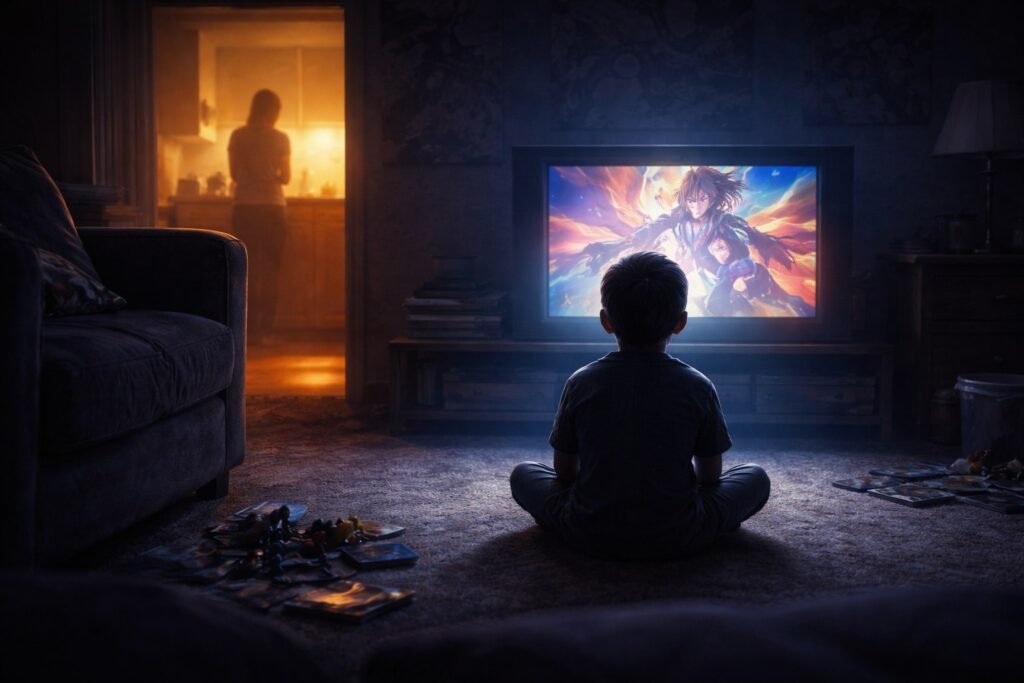
Your mom thought it was cartoons.
She heard the TV on in the living room after school, glanced at the screen, saw bright colors and spiky hair, and went back to making dinner. Maybe she told you to turn it down. Maybe she didn’t even do that. It was Cartoon Network. The channel had “cartoon” in the name. It was safe. It was for kids. She had no reason to look closer.
Meanwhile, you were watching a man die in front of his son while confessing that holding him as a baby was the only time he’d ever felt pride in himself. You were watching a teenage soldier self-destruct his own weapon of war rather than let it fall into enemy hands. You were watching a team of fighters in a death tournament where the penalty for losing was literally death. You were eight years old.
And your parents had absolutely no idea.
The Loophole Nobody Planned
Here’s what happened. In the late 1990s, anime arrived on American television through a backdoor. Cartoon Network’s Toonami block, which aired weekday afternoons starting in 1997, was designed for kids aged 7 to 18. The shows it aired came from Japan, where they had been written for audiences ranging from children to adults. But in America, they all landed on the same channel, in the same time slot, between 4 and 6 PM, when elementary and middle school kids were home and parents were still at work or making dinner in the next room.
The shows were edited. Blood was painted over. Death was rewritten. Dialogue was softened. But the bones of these stories, the themes, the emotional weight, the ideas about sacrifice and violence and loss and identity, couldn’t be edited out. You can remove the blood from a scene where a father dies protecting his son. You cannot remove the fact that a father died protecting his son.
This wasn’t a conspiracy. Nobody at Cartoon Network was trying to sneak mature content past parents. Funimation, which distributed Dragon Ball Z, deliberately targeted the young children’s market because in the late 1990s, that market was bigger than the anime market. Saban Entertainment, their distribution partner, enforced strict censorship guidelines designed to make the show safe for the youngest possible audience. The intention was to make these shows appropriate for American kids.
The result was something nobody anticipated. An entire generation watched stories about war, death, sacrifice, trauma, and moral complexity on a channel their parents assumed was showing the same kind of thing as Dexter’s Laboratory. The content was mature. The delivery system was children’s television. And nobody was checking.
What Was Actually on the Screen
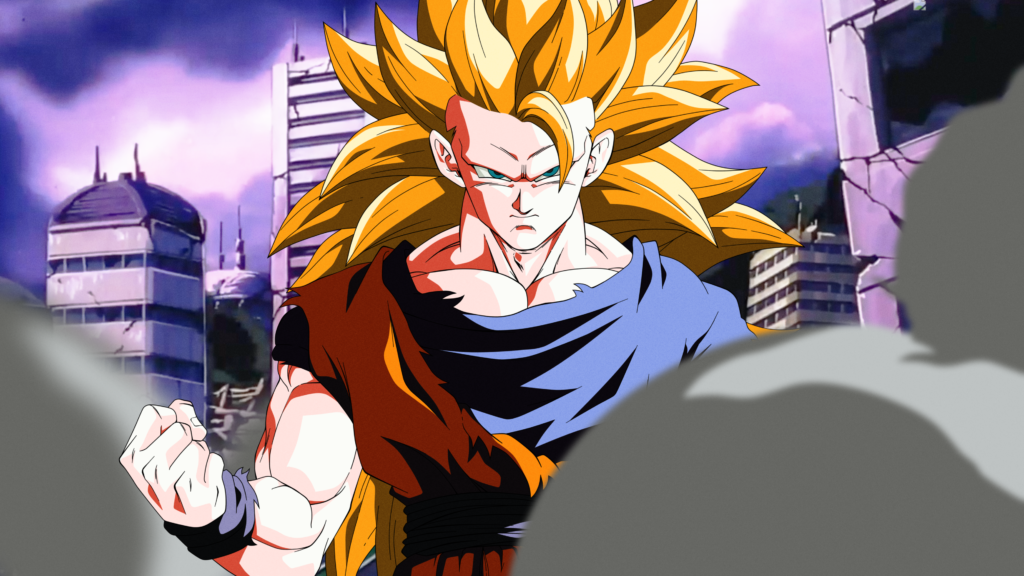
Dragon Ball Z was rated TV-Y7-FV on Cartoon Network. That rating means the show was deemed suitable for children seven and older, with a note about fantasy violence. Common Sense Media, a nonprofit that reviews media for parents, found that most parents felt the show wasn’t suitable for children under ten. The edited Toonami version still featured extended fight sequences, characters being beaten to the edge of death, the complete destruction of planets, and storylines built around grief, revenge, and self-sacrifice.
The Saban censors changed death to “another dimension.” They turned Hell into “H.F.I.L.” They digitally removed tears from a child’s face. But they couldn’t change the fact that Vegeta, the show’s most complicated character, stood in front of an enemy he knew he couldn’t beat and chose to blow himself up to protect his family. They rewrote the dialogue. They edited around the explosion. But every kid watching understood exactly what happened. Vegeta died. He chose to die. And he did it for the people he’d spent the entire series pretending not to care about. You understood that at eight years old, sitting on your living room floor, while your mom was in the kitchen.
Gundam Wing premiered on Toonami in March 2000 at 5:30 PM. The show is about five teenage boys, all fifteen years old, who are trained as soldiers and sent on suicide missions to fight a corrupt military government. Heero Yuy, the main character, tries to self-destruct in the first few episodes. The show deals with political assassination, colonialism, the morality of armed resistance, and the psychological cost of turning children into weapons. It aired right after Dragon Ball Z on a channel for kids.
Get the history behind the stories.
One email a week. Read it before it hits the feeds.
The afternoon version was censored. The word “kill” was replaced with “destroy.” Duo Maxwell’s nickname was changed from “The God of Death” to “The Great Destroyer.” Blood was removed. But the story was still about child soldiers fighting a war that adults started. No amount of dialogue editing could change that premise. If your parent walked in during an episode of Gundam Wing, they saw giant robots. What they didn’t see was the show quietly asking their kid to think about whether violence can ever be justified, and what happens to a person who is raised to believe their life is worth less than their mission.
Sailor Moon’s first season finale features the main character watching every one of her friends die. In the original Japanese version, they are killed in battle one by one. The DiC dub rewrote those deaths as the characters being “captured by the Negaverse.” But the music changed. The tone shifted. The voice acting carried the weight of something irreversible. Every kid watching understood that something terrible had happened, even if the dialogue tried to tell them otherwise. The gap between what the words said and what the scene showed was the first time a lot of American kids experienced subtext without knowing the word for it.
Yu Yu Hakusho originally aired on Adult Swim, Cartoon Network’s late-night block for adults. It was moved to Toonami’s afternoon block in 2003, where it was edited for a younger audience. The uncut version featured heavy profanity, graphic violence, and themes of death throughout. The edited version cut the profanity, trimmed the violence, and softened references to death. But the Dark Tournament saga, where fighters die in the ring and the emotional stakes are built around characters protecting each other at the cost of their own lives, aired on afternoon television for kids coming home from school. Funimation president Gen Fukunaga said the show “came out of nowhere to surprise people with huge ratings.” It surprised people because it was airing at 4 PM on a children’s network and pulling numbers that rivaled Dragon Ball Z.
The Moment Your Parent Walked In
Every single person who watched Toonami has this story. The specific moment a parent, grandparent, or older sibling walked into the room during exactly the wrong scene. Maybe it was during a particularly intense DBZ fight where someone was getting beaten so badly the screen was shaking. Maybe it was during a Gundam Wing scene where a character was giving a speech about whether it’s better to die fighting or live as a coward. Maybe it was during Yu Yu Hakusho’s Dark Tournament when someone was bleeding from a wound the censors missed.
And you had to explain it. Or worse, you had to pretend you hadn’t been paying attention. “It’s just a cartoon.” That was the defense. That was always the defense. Because if you tried to explain that actually, this show is about the nature of war and the psychological damage of child soldiers, you were getting the TV turned off and probably grounded.
So you learned to manage the situation. You knew which episodes were safe for parental walk-ins and which ones required you to keep the remote within reach. You developed a sixth sense for footsteps in the hallway. You learned to change the channel fast and change it back faster. You became an expert at casual viewing, at making it look like you were barely paying attention to the screen when in reality this show was reshaping how you understood storytelling.
What It Actually Did to You
Here’s the part nobody writes about. The content wasn’t harmful. It was formative. Those shows, the ones your parents didn’t know you were watching, taught you things that American children’s television at the time wasn’t designed to teach.
Dragon Ball Z taught you that strength isn’t enough. That Goku, the strongest fighter in the universe, stepped aside and trusted his son to finish the fight against Cell because he recognized that being the strongest isn’t always the same as being the right person for the moment. That’s a lesson about leadership, humility, and trust that most American cartoons in 1999 weren’t even attempting.
Gundam Wing taught you that wars don’t have clear good guys and bad guys. That the people fighting for freedom can become just as destructive as the people they’re fighting against. That a fifteen-year-old being forced to kill isn’t heroic. It’s tragic.
Sailor Moon taught you that emotion isn’t weakness. That the main character cries constantly and is clumsy and imperfect and STILL saves the world, because her strength comes from her relationships and her refusal to stop caring about people even when caring hurts.
Yu Yu Hakusho taught you that a person’s worst reputation doesn’t define their capacity for good. That Yusuke Urameshi, a teenage delinquent who the entire world had written off, died saving a child and was given a second chance he didn’t think he deserved.
These aren’t lessons from children’s cartoons. These are themes from literature, from film, from the kind of storytelling that most people don’t encounter until they’re much older. An entire generation got them at age eight, nine, ten, sitting on the floor after school, on a channel their parents thought was harmless.
The Real Story
Anime on Toonami existed in a gap. The content was too sophisticated for the rating. The rating was too childish for the content. And in that gap, millions of kids encountered storytelling that was more emotionally complex, more morally ambiguous, and more willing to take them seriously than anything else on American television.
Your parents didn’t know. They weren’t supposed to know. Not because anyone was hiding it, but because the system wasn’t built to communicate what anime actually was. It was animation, so it went on the animation channel. It was from Japan, so Americans applied American standards to it. It was bright and colorful, so it must be for kids. Every assumption was wrong. And every kid who watched knew it was wrong. They just couldn’t explain it.
You didn’t need your parents to understand what you were watching. You understood it fine. And the proof is that you’re reading this article right now, remembering exactly which show, which scene, and which living room moment this is about.
So which one was it? Which scene was playing when someone walked in and you had to pretend it was “just a cartoon”? Was it Vegeta’s sacrifice? Heero’s self-destruct? The moment Sailor Moon watched her friends fall? Or was it something else entirely, a scene that stuck with you for decades because you had to process it alone, at eight years old, while your mom was in the other room? We want to hear the story you’ve never told anyone.
read now
MORE LIKE THIS
-
The Big O Was Cancelled in Japan After 13 Episodes. It Was So Popular in America That Cartoon Network Helped Fund the Other Half.
6 MIN READ -
Serial Experiments Lain Was Made by a Team With Almost No TV Anime Experience. The Character Designer Had Never Worked on an Anime Before.
5 MIN READ -
Attack on Titan Was Rejected for Being Too Dark. The Teenager Who Created It Refused to Change It. It Crossed Into the Prestige-TV Mainstream That Anime Almost Never Reaches.
7 MIN READ

Co-founder and co-host. Veteran. Grew up on cartoons. The MCU brought all of it back and pulled him into the comics side he never picked up as a kid. Curious by default. Passionate without needing to prove anything. Good at holding a conversation.