
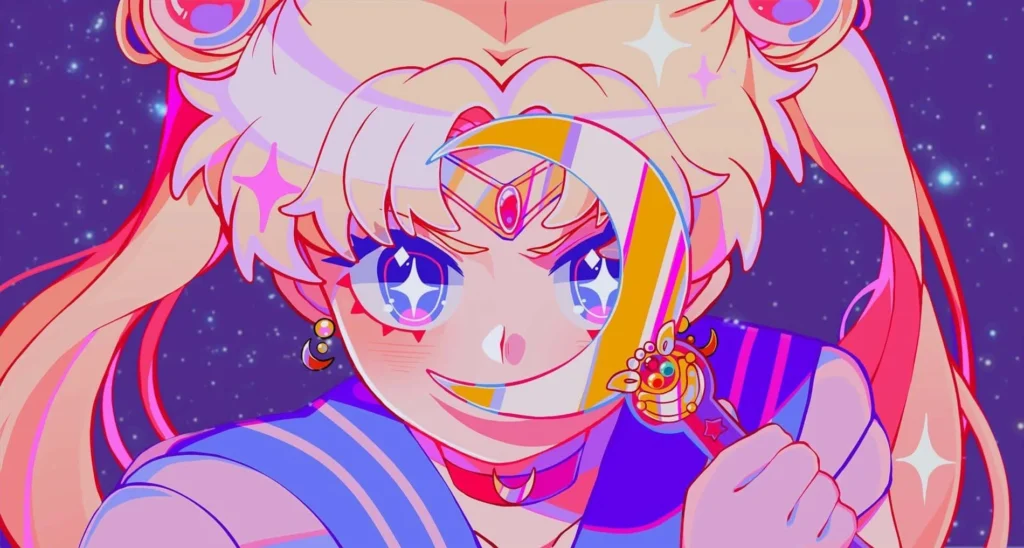
Sailor Moon Was Cancelled, Saved by a Fan Campaign That Weaponized Pop-Tarts, and Changed What Toonami Was Allowed to Be.
By Jimigrimm
You didn’t pick Sailor Moon. Sailor Moon picked you. Maybe you were flipping channels after Dragon Ball Z and there she was, a clumsy teenage girl tripping over her own feet one minute and destroying a monster with a tiara the next. Maybe you were a girl who had been watching Toonami for the action and suddenly realized there was a show that looked like it was made for you. Maybe you were a boy who kept watching even though your friends said it was a “girl show” because something about the storytelling pulled you in and wouldn’t let go.
Whatever brought you to Sailor Moon, the show almost didn’t make it to your screen. The story of how it got there involves a failed syndication run, a fan campaign that specifically targeted breakfast food, and a programming decision that proved Toonami could be more than a boys’ action block.
Naoko Takeuchi Built a Universe
Sailor Moon started as a manga by Naoko Takeuchi, serialized in the Japanese magazine Nakayoshi beginning in 1992. Takeuchi was a pharmacology student who had already published manga before creating the series that would define her career. The anime adaptation premiered on TV Asahi on March 7, 1992, and ran every Saturday night at 7pm in Japan for five years, averaging 11 to 12 percent viewer ratings across its run. It was massive. Five seasons, 200 episodes, three theatrical films. In Japan, Sailor Moon wasn’t niche. It was prime time.
But getting it to America was a disaster.
The First Failure
In 1995, DiC Entertainment won the rights to Sailor Moon after a bidding war with Toon Makers, who had pitched an absurd live-action/animated hybrid that fans would later dub “Saban Moon.” DiC hired Optimum Productions in Canada to dub the anime and created an adaptation designed to capitalize on the success of Mighty Morphin Power Rangers.
The changes were extensive. Usagi became Serena. Mamoru became Darien. Attack names were rewritten. The entire musical score was replaced. Six episodes were cut outright from the first two seasons. The final two episodes of season one, which contained the deaths of the Sailor Senshi, had so much footage removed that they were merged into a single episode. The deaths were rewritten as the characters being “kidnapped by the Negaverse.” Every “Sailor Senshi” became a “Sailor Scout.” And in later seasons, Sailor Uranus and Sailor Neptune’s romantic relationship was rewritten to make them cousins, while keeping all the original flirtatious dialogue intact, which unintentionally created one of the most talked-about localization decisions in anime history.
DiC released 65 episodes in U.S. syndication starting September 11, 1995. The show performed well in Canada on YTV, where it aired in a consistent afternoon slot. In America, local stations buried it in early morning time slots where the target audience couldn’t find it. By November 1995, it was cancelled. DiC dropped it. The final 17 episodes of the second season were left undubbed. Sailor Moon was dead in America after less than three months.
The Fans Brought It Back
What happened next is one of the earliest examples of organized fan activism saving a television show.
Get the history behind the stories.
One email a week. Read it before it hits the feeds.
A group called Save Our Sailors launched a campaign to bring Sailor Moon back. They built a website, organized petition drives, and gathered over 12,500 signatures demanding the show’s return. But signatures weren’t enough. The fans got strategic. They identified General Mills as a potential sponsor and organized what they called a “procott,” the opposite of a boycott. They bought Pop-Tarts and other General Mills products in bulk specifically to demonstrate consumer demand, then contacted the company directly to show them there was an audience willing to spend money.
It worked. In 1997, General Mills agreed to sponsor and syndicate Sailor Moon through its subsidiary The Program Exchange. DiC dubbed the remaining 17 episodes of Sailor Moon R, marketed as “The Lost Episodes.” The show returned to the USA Network in June 1997. And on June 1, 1998, Sailor Moon began airing on Cartoon Network’s Toonami block.
The Show That Changed the Block
Sailor Moon hit Toonami at the same time as Dragon Ball Z, and the pairing was a stroke of genius. DBZ was action-driven shonen aimed primarily at boys. Sailor Moon was character-driven shojo that brought girls into the audience in numbers Toonami had never seen.
The show proved that heroism on Toonami didn’t have to look one way. Usagi wasn’t a warrior who trained for battle. She was a clumsy, emotional, imperfect girl who cried constantly and still saved the world. Her power came from compassion, from her relationships, from her refusal to give up on the people she loved. That was a radically different model of strength from anything else on the block, and it resonated with viewers who had never seen themselves in an action lineup before.
There’s a moment in the first season where Usagi watches her friends fall one by one in the battle against Queen Beryl’s forces. In the original Japanese, they die. In the DiC dub, they’re “captured.” But even through the censorship, even with the rewritten dialogue, you felt the weight. You understood that something irreversible had happened. The music shifted. Usagi’s voice broke. And a show that had spent 30-something episodes being funny and lighthearted suddenly asked you to sit with real loss. If you were watching on Toonami, that was the episode that changed your relationship with the show. You came in for the transformation sequences and stayed because the story earned something you didn’t expect to feel.
Toonami promoted the final 17 “Lost Episodes” of Sailor Moon R as an event, holding them until fall 1998 when viewership would be higher than the summer months. Cloverway, the U.S. branch of Toei Animation, later produced dubs of Sailor Moon S and SuperS, which premiered on Toonami in 2000. The fifth season, Sailor Stars, was never licensed for American broadcast due to content Toei believed would be considered objectionable, leaving the story incomplete in English for nearly two decades.
A Legacy That Outlasted the Censorship
The DiC dub was imperfect. Fans knew it at the time. The censorship frustrated viewers who discovered the uncut Japanese version through fansubs and imports. The name changes, the rewritten deaths, the cousin situation with Uranus and Neptune, all of it became part of the conversation about how anime was treated when it crossed the Pacific.
But the impact was undeniable. Sailor Moon on Toonami proved that anime aimed at girls could perform alongside anime aimed at boys on the same block. It influenced a generation of artists and creators who grew up watching it. Rebecca Sugar, creator of Steven Universe, has cited Sailor Moon as a foundational influence. The magical girl genre in Western awareness traces directly back to Sailor Moon’s Toonami run. Before it aired, most American viewers had never seen a show where a team of superpowered girls saved the world every week with love, friendship, and genuinely high emotional stakes.
Naoko Takeuchi married Yoshihiro Togashi, the creator of Yu Yu Hakusho, in January 1999. Two of Toonami’s golden era staples were created by a married couple. Their wedding was attended by voice actors from both anime series. That detail is almost too perfect.
In 2014, Viz Media acquired the rights to Sailor Moon and produced a completely new, uncut English dub with the original Japanese names, story elements, and relationships intact. For the first time, American fans could hear “Usagi” instead of “Serena” in English. In May 2024, that Viz dub began airing on Toonami Rewind, returning Sailor Moon to the block after 24 years. The show that fans organized a Pop-Tart campaign to save came back to the place where it mattered most.
Do you remember which Sailor Moon moment made you realize the show was more than you expected? Was it the season one finale? The first time a transformation sequence gave you chills instead of making you laugh? The moment you realized you cared about these characters more than you thought you would? And if you were one of the fans who watched it knowing the DiC dub wasn’t the real version, when did you finally see the original? We want to hear both sides of that story.
MORE LIKE THIS
-
Dragon Ball Z Was Cancelled Twice in America Before Toonami Turned It Into the Biggest Anime on the Planet.
7 MIN READ -
Anime Didn’t Start With Toonami. It Took 35 Years of Bootleg Tapes, Borrowed Robots, and One Movie That Changed Everything to Get There.
6 MIN READ -
The Big O Was Cancelled in Japan After 13 Episodes. It Was So Popular in America That Cartoon Network Helped Fund the Other Half.
6 MIN READ
Co-founder and co-host. Veteran. Grew up on cartoons. The MCU brought all of it back and pulled him into the comics side he never picked up as a kid. Curious by default. Passionate without needing to prove anything. Good at holding a conversation.